Are you someone who wants to know how much it costs to develop a fitness app? Then you’ve landed in
the right place! Nowadays, people understand the importance of good health. They’re resorting to a
number of ways to improve their personal well-being, one of which is fitness apps. These digitally
advanced tools have become a go-to choice for people. From tracking fitness journeys to getting
tailored suggestions on daily meal intake, people rely on digital health tools for guidance.
Statistical reports from Grand View Research suggest that there will be substantial growth in the
fitness app market from 2024 to 2030 by 17.7% CAGR, which was previously valued at
$1.54 billion
in 2023. Isn’t this data enough to define the scope of fitness app development? So, if you want to
create a fitness app and want to know about the cost of developing a fitness app, this is the only
guide you’ll ever need! Get ready to get exact insights about the fitness app development cost.
Determining Fitness App Development Cost(With Prices and Timeline)
The fitness app development cost can be around 25,000-2,00,000(USD), depending on the various
aspects. Let’s delve deeper into the factors that determine the cost of developing a fitness app:
Please Note: The prices below and the final cost of the fitness app may vary depending on the type
of
app you want to build and the number of features you want to incorporate.
#1 Factors Determining Fitness
App Development Cost: App Features
| Section | Features | Estimated Price (in USD) |
|---|---|---|
| Section A: Basic Features | User Onboarding, App Dashboard, Workout Features, Nutrition and Meal Planning, Social Fitness Community, Admin Panel |
25000-80000 |
| Section B: Advanced Features(3rd Party Integrations) | Analytics, Payment Gateway, POS (Point of Sale), Push Notifications, Wearable Integration, CRM (Customer Relationship Management), Email and SMS, Crash Logs, Booking Management, Other Integrations |
15000-1,20,000 |
Section A: Basic Features
Estimated Price (in USD): 25000-80000
-
User Onboarding
The first and foremost feature of a fitness app is User Onboarding. It is the starting point
where the user interacts with the app. You wouldn’t want to lose your audience in the first
instance, right? So, you need to focus on building an intuitive interface coupled with the
necessary features to help your users get started! User Onboarding includes the following
important features:-
Sign Up and Login: Allows your users to easily create an account
using
their personal details such as name and contact number or log in using their
existing
email, social media, or phone ID such as Apple ID. -
Profile Creation: Enable users to create their profile by adding
basic
information such as age, gender, location, etc. -
Profile Setup: Includes information such as your current weight,
height, health condition, workout, and diet preferences. -
Goal Setting: Let your user set desired fitness goals, such as
bulking,
cutting, or muscle building, and allow them to choose exercise routines and
challenges
tailored to their preferences and daily schedule. -
Free or Subscription-Based Signup: Allow users to use basic
features
for free or pay a small subscription fee to access premium features.
-
-
App Dashboard
Once we’ve completed the user onboarding process, we’ll move on to the app dashboard. This
is like a central hub for all features, where users can locate and interact with key aspects
such as exercises and workout challenges, track their progress, view deals and offers, and
access other app functions.-
Fitness and Diet Plans: Highlights numerous fitness and meal
options
for users to choose according to their goals and preferences. -
Deals and Offers: The dashboard displays exclusive deals and offers
on
fitness programs or products, such as supplements or equipment. -
Track Your Progress: The app interface will showcase a progress bar
informing your users where they stand in their fitness journey.
-
-
Workout Features
Workouts are the core aspects of any fitness app. Important workout features are workout
plans, challenges, a diverse workout library, video instructions for various exercises, and
before/after pictures.-
Workout Library: Give your users the freedom to choose from a
variety
of workout routines, including both gym or home-based exercises that suit their
fitness
goals. -
Workout Challenges: Provide the motivation your users need by
offering
engaging workout challenges that add a sense of competitive element to their fitness
journey. -
Before and After Images: Enabling users to upload their
before-and-after pictures allows them to track their progress visually. -
Video Instruction: Enable high-quality guidance videos on various
exercises to inform users and ensure they perform the correct form and technique.
-
-
Nutrition and Meal Planning
Just following workout routines is not enough; users need a proper diet to complement their
fitness activities. Crucial nutrition planning features such as meal planning, calorie
tracking, timely meal reminders, meal suggestions, etc., ensure your users meet their
dietary goals.-
Calorie Tracking: Allow your users to log in to their everyday food
intake to monitor calorie consumption accurately for each meal. -
Meal Planning: Let users choose from various meal options or create
plans tailored to their nutritional needs and fitness goals. -
Recipe Library: Offer your users a collection of healthy recipes
with a
list of ingredients and cooking instructions. -
Meal Scheduling and Reminders: Enable users to schedule their meal
intake and receive reminders to eat at dedicated times, guaranteeing they stay
consistent with their diet.
-
-
Social Fitness Community
The social fitness community aspect is one of the most innovative features that connects
like-minded people who support each other during their fitness journey. Social interaction
instills a sense of community, enhancing user experience and retention.-
Community Setup: Create a platform where your app users can
connect,
make groups, follow other users, and interact with the community. -
Engagement Features: Include functionalities like posting updates,
commenting, liking, and sharing content to keep users engaged. -
Live Streaming: Allows fitness trainers or users to stream live
workout
sessions, providing real-time interaction and motivation. -
On-Demand Content: Allow users to access pre-recorded workout
videos
and fitness content at their convenience. -
Flag and Report Users: Ensure a safe community by allowing users to
flag and report inappropriate behavior or content.
-
-
Admin Panel
The Admin Panel lets the app administrator manage and make necessary adjustments within the
fitness app. Admin has control over aspects such as workout or challenge creation, handling
members, staff, bookings, payments, etc.-
Workout and Challenge Creator: Admins can create and manage workout
plans and fitness challenges, tailoring content to meet user needs. -
Member and Staff Management: Tools for managing user accounts and
staff
roles, ensuring proper access control and user support. -
Bookings: Enables the scheduling and management of appointments or
classes, providing an organized system for users and trainers. -
Reporting: Comprehensive reporting tools that provide insights into
app
performance, user engagement, and financial metrics. -
Promo Code Management: Feature allows admin to create, distribute,
and
manage promotional codes for discounts and special offers. -
Payment and Subscription Management: Tools for handling payment
processing, subscription plans, and billing, ensuring smooth financial operations.
-
-
Section B: Advanced Features(3rd Party
Integrations)Estimated Price (in USD): 15000-1,20,000
3rd Party Integrations are essential for enhancing the functionality and user experience of
a
fitness app. These integrations allow the app to connect with various external services and
devices, providing users with a more comprehensive and seamless experience. The number of
3rd-party integrations can significantly impact the cost to develop a fitness app.-
Analytics: Integration with analytics platforms to track user
behavior
and app performance, enabling data-driven decision-making. -
Payment Gateway: Provide Secure payment processing for
subscriptions
and in-app purchases. -
POS (Point of Sale): Enable in-app transactions for physical goods,
like fitness equipment or merchandise. -
Push
Notifications: Provide a feature for sending timely reminders
and updates to keep users engaged and informed. -
Wearable Integration: Connects with fitness trackers and wearable
devices to sync activity data and provide personalized insights. -
CRM (Customer Relationship Management): Helps manage user
relationships
and interactions, enhancing customer support and retention. -
Email and SMS: Facilitates
communication
with users through automated email and SMS notifications. -
Crash Logs: Collects and analyzes crash reports to improve app
stability and performance. -
Booking Management: Offers a system for scheduling and managing
appointments, classes, or personal training sessions. -
Other Integrations: Includes additional third-party services like
maps
for location-based features, social media for sharing progress, health data
repositories
for comprehensive user health insights and many more.
-
#2 Factors Determining
Fitness App Development Cost: App’s Complexity
| Complexity of App | Estimated Price (in USD) |
|---|---|
| Basic Fitness App | 25,000 – 80,000 |
| Highly Complex Fitness App | 1,00,000 – 2,00,000 |
The complexity of a fitness app can have a significant impact on the cost and time taken to create
it. But how can one know the app’s complexity? Simply by knowing the features involved. There are
three types of fitness apps based on complexity level. Basic, Intermediate, and Highly Complex. Let
us understand them:
-
Basic Fitness App
A basic fitness app includes fundamental features from section A mentioned above. It’s
suitable for users looking for essential fitness functionalities without advanced
integrations.-
Features: User Onboarding, App Dashboard, Workout Features,
Nutrition
and Meal Planning, Social Fitness Community, Admin Panel -
Estimated Price (in USD): 25,000-80,000
-
-
Highly Complex Fitness App
A highly complex fitness app includes all important and advanced features from Sections A
and
B simultaneously. It especially focuses on the needs of professional athletes, fitness
enthusiasts, and businesses looking for a top-tier fitness solution.-
Features: User Onboarding, App Dashboard, Workout Features,
Nutrition
and Meal Planning, Social Fitness Community, Admin Panel and Advanced features (3rd
Party Integrations) including Wearables, CRM systems, Full-featured Admin Panel,
User/Member Management, Reporting, Promo Code Management), Booking Management, etc. -
Estimated Price (in USD): 1,00,000-2,00,000
-
#3 Factors Determining
Fitness App Development Cost: Custom Requirements
Remember, no two apps are the same, and it’s also important to build unique solutions if you’re
looking to stand out. Apart from basic and important features, your fitness app might need unique
functionalities that fit your business needs. At Wegile, we understand that every client has
distinct goals and visions for their app.
Our 10+ years of fitness app development experience allows us to create tailored solutions as per
the
exclusive needs of business. We closely partner with you to understand your unique requirements and
on that basis, we offer bespoke fitness app solutions. To get started, simply get in touch with us,
brief us on your requirements, and we will provide you with a detailed pricing estimate and a
dedicated timeline tailored to your project.
#Bonus
Tip: How to Reduce Fitness App Development
Cost?
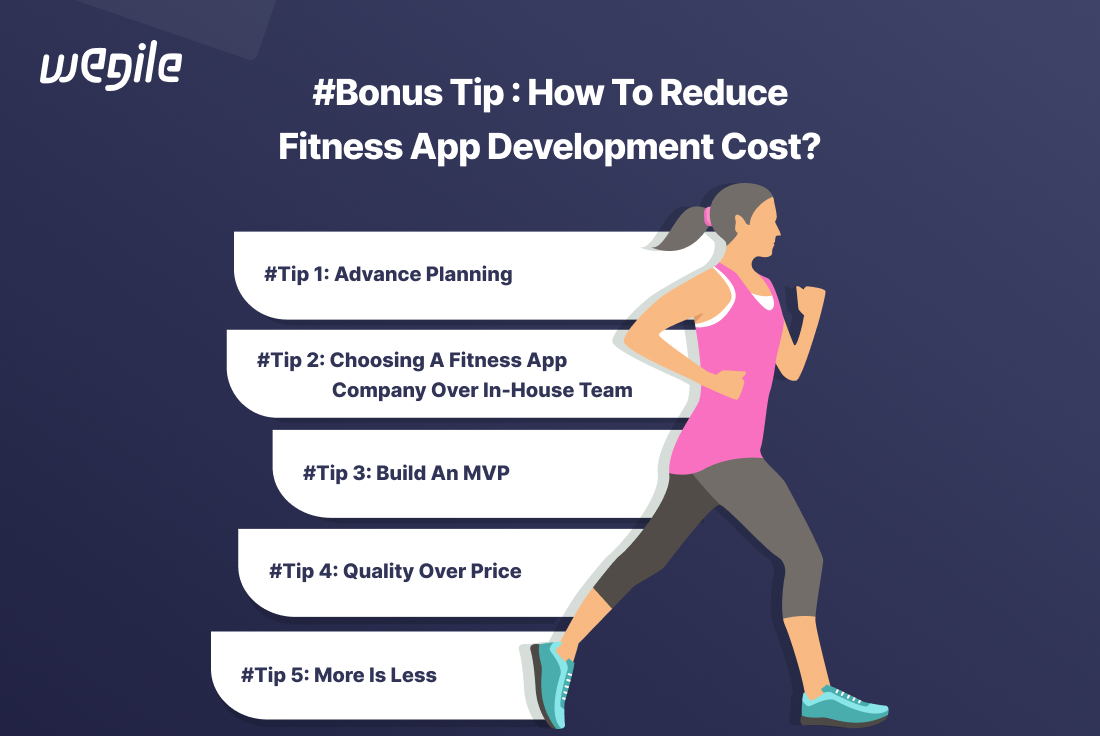
#Tip 1 to Reduce Fitness
App Development Cost: Advance Planning
Advance planning is crucial for minimizing fitness app development cost. By clearly defining your
app’s features, target audience, and objectives beforehand, you can streamline the development
process and avoid unnecessary costs later on. This involves creating detailed project
specifications, wireframes, and timelines to ensure all stakeholders are aligned from the beginning.
#Tip 2 to Reduce Fitness App Development Cost:
Choosing a Fitness App Development Company over an In-house Team
Opting for a fitness app development company or hiring fitness app developers instead of building an
in-house team can significantly reduce costs and streamline the development process. Here’s a
comparison to illustrate why hiring a company is often a better option:
| Criteria | Fitness App Development Company | In-house Team |
|---|---|---|
| Cost | Typically, it is more cost-effective and reliable | Higher costs due to salaries and overhead expenses |
| Expertise | Access to a team of experienced professionals with diverse skills | Limited expertise; may need to hire additional specialists |
| Time to Market | Faster due to established processes and workflows | Slower due to recruitment, training, and setup times |
| Scalability | Easily scalable to meet project demands | Challenging to scale quickly; limited by team size and budget |
| Quality Assurance | Proven QA processes and dedicated QA teams | May require additional resources for quality assurance |
| Flexibility | Flexible engagement models (fixed price, hourly, retainer) | Less flexibility; committed to salaries and long-term contracts |
By choosing a fitness app development company like Wegile, you can leverage their established
expertise, resources, and streamlined processes, resulting in a more efficient and cost-effective
development cycle. This allows you to focus on your core business while ensuring your fitness app is
developed to the highest standards.
Also Read: Top 5 Leading
Fitness
Apps Developed by Wegile
#Tip 3 to Reduce Fitness App
Development Cost: Build an MVP (Minimum Viable Product)
Building an MVP is an effective
strategy to reduce initial costs while validating your app idea. An MVP includes only the core
features necessary to solve the primary problem for your users, allowing you to launch quickly and
gather user feedback.
Benefits of an MVP:
-
Cost-Efficiency: Focuses on essential features, reducing development time
and
cost. -
User Feedback: Collects real user insights to refine the product.
-
Faster Time Market: Allows for quick launch and iteration.
#Tip 4 to Reduce Fitness
App Development Cost: Quality Over Price
When it comes to app development, quality should always be given preference over the fitness app
development cost. Opting for cheaper solutions might save money upfront but can lead to higher
expenses later due to poor performance, frequent bugs, and user dissatisfaction.
-
Long-term Savings: Investing in quality app development services ensures
your
app functions smoothly, reducing the need for costly fixes and updates afterward. -
User Satisfaction: A high-quality app provides a better user experience,
which
can lead to higher retention rates and positive reviews. -
Brand Reputation: A well-developed app reflects positively on your brand,
helping to build trust and credibility with your users.
Choosing quality over price ensures that your app is reliable, efficient, and capable of meeting
user
expectations, ultimately providing better returns on your investment.
#Tip 5 to Reduce Fitness App
Development Cost: More is Less
Adding too many features to a fitness app can be overwhelming for users and increase development
costs unnecessarily. Focus on building a streamlined app with the most valuable features first.
Discuss your goals and ideas
with the
company you’re hiring; their experience will help you decide which features to prioritize. This
approach reduces unnecessary costs and enhances user experience by providing a clean and
easy-to-navigate interface.
Wrapping Up
Understanding the fitness app development cost is essential for creating a successful and
user-friendly product. By focusing on core features and avoiding unnecessary additions, you can
develop a streamlined app that meets user needs without overspending. Effective planning and
prioritizing quality ensure a smooth development process and a high-quality final product. At
Wegile, we provide tailored solutions that help you navigate the complexities and challenges of
fitness app development while ensuring you have a top-notch app. Partner with a leading fitness app development
company to transform your vision into an exceptional fitness app.
Leave a Reply