In the digital age, social media platforms have transcended their initial purpose of connecting
people, evolving into powerful tools for engagement, marketing, and even global influence. At the
heart of every successful social media application lies a meticulously chosen development framework
that shapes its functionality and capacity to adapt and scale in a rapidly changing digital
landscape. Selecting the right technology for social media app development is not just a technical
decision; it’s a strategic move that determines the app’s resilience, user experience, and,
ultimately, its success in the competitive tech arena. This decision intertwines with the
technological stack, comprising various programming languages, tools, and platforms, each playing a
pivotal role in the app’s lifecycle from conception to deployment. As we delve into this topic, we
aim to shed light on the intricacies of technology selection, exploring factors like scalability,
performance, and security, which are often overlooked yet critical for the longevity and impact of a
social media application. Keep reading as we will explore crucial social media app development
technologies.
The
Role of Frameworks in Social Media App
Development
-
1. The Architectural Backbone of Social
Media AppsFrameworks in social media app development serve as the architectural backbone, providing a
structured foundation for the app’s features and functionalities. They offer a set of
pre-written, standard code, tools, and libraries that developers can leverage to create
robust, scalable, and efficient applications. This architectural support is crucial,
particularly in social media platforms, where user interaction and data processing need to
be seamless and real-time. A well-chosen framework can significantly reduce development
time, enforce best practices, and ensure consistency across the app’s user interface and
backend services. It’s the framework that enables developers to focus on innovating unique
features rather than reinventing the wheel for common functionalities, thus accelerating the
path from concept to market. -
2. Front-end Frameworks
Front-end frameworks play a pivotal role in defining the look, feel, and overall user
experience of social media apps. These frameworks, such as Angular, React.js, and Vue.js,
provide developers with a rich set of tools and components to create dynamic, responsive,
and interactive user interfaces. In the realm of social media, where user engagement is key,
the choice of front-end framework can significantly impact the app’s ability to attract and
retain users. These frameworks facilitate the development of seamless navigation flows,
real-time updates, and interactive elements that encourage user interaction and content
sharing. By abstracting the complexities of raw web development technologies, front-end
frameworks enable developers to craft intuitive and immersive social media experiences with
greater efficiency and creativity. -
3. Supporting Technologies
In the ecosystem of social media app development, supporting technologies like cloud services
and DevOps tools play a critical, yet often underappreciated, role. Cloud platforms such as
AWS and Google Cloud provide the scalable infrastructure necessary to support the
fluctuating volumes of user data and traffic inherent in social media apps. This scalability
ensures that as the user base grows, the app’s performance remains unaffected, providing a
seamless user experience. Additionally, DevOps
practices and tools,
including continuous integration and deployment pipelines, foster a culture of rapid
development and deployment, allowing for frequent updates and improvements. This agility is
key to maintaining the relevance and competitiveness of social media platforms in a
fast-paced market. -
4. Emerging Technologies
Emerging technologies such as artificial intelligence (AI), augmented reality (AR), and
blockchain are setting the stage for the next evolution of social media apps. AI and machine
learning algorithms are being increasingly employed to personalize user experiences,
moderate content, and enhance user engagement through intelligent recommendations. AR, on
the other hand, offers new ways for users to interact with content, adding layers of
immersion and interactivity that were previously unattainable. Blockchain technology
promises enhanced security and privacy, offering decentralized solutions that could redefine
user trust and data ownership. These technologies, though in their nascent stages within the
social media domain, hold the potential to radically transform how we connect, share, and
experience social media.
Technologies Involved in Social Media App Development
-
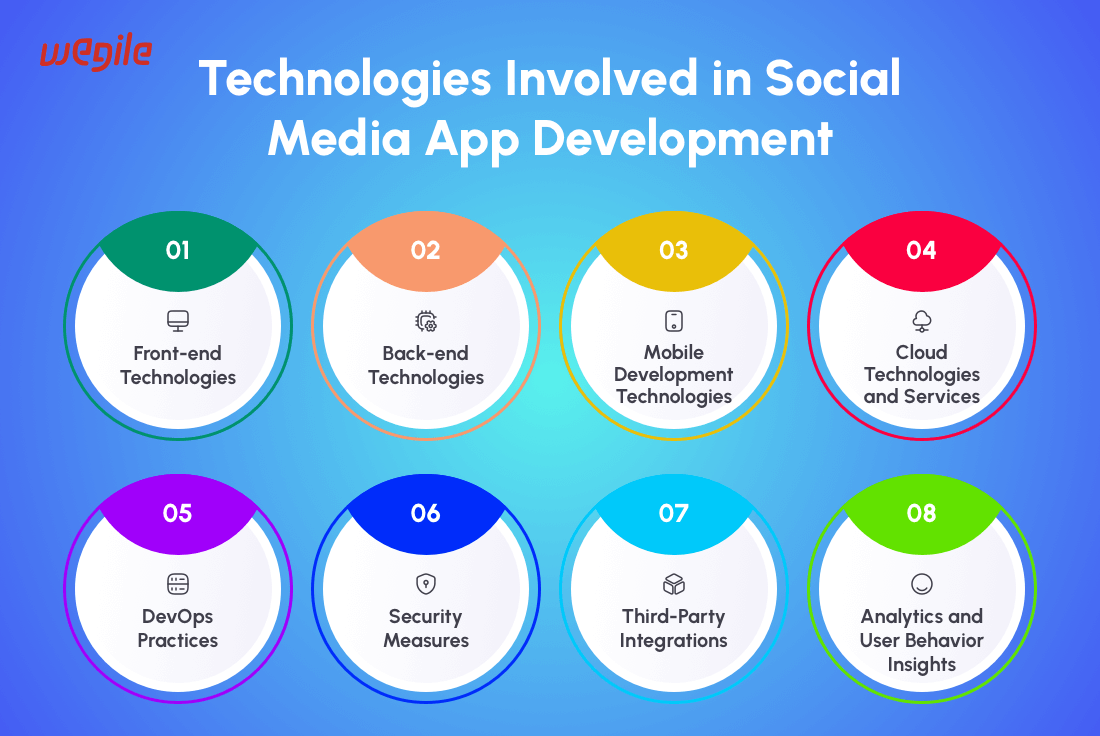
1. Front-end Technologies
Front-end technologies are the first point of interaction between a social media app and its
users, making them a critical component in app development. While frameworks like Angular,
React.js, and Vue.js are commonly discussed, less attention is often paid to the innovative
use of CSS preprocessors like Sass and Less, which streamline and enhance stylesheet
capabilities, enabling richer, more responsive user interfaces. Moreover, the adoption of Progressive web apps (PWAs)
technology is transforming the landscape, offering app-like experiences within browsers that
blur the line between web and mobile apps. These technologies create intuitive, engaging,
and visually appealing social media platforms that captivate and retain users. -
2. Back-end Technologies
While front-end technologies capture the user’s attention, back-end technologies are the
unsung heroes ensuring the app’s performance, scalability, and security. Beyond popular
frameworks like Node.js and Django, using graph databases such as Neo4j in social media app
development is a game-changer. These databases excel in handling complex and interconnected
data typical of social networks, providing faster query responses and a more natural fit for
social graphing features. Additionally, the integration of serverless architectures and
microservices is revolutionizing back-end development, offering unprecedented scalability
and efficiency. These advanced technologies enable developers to build more robust,
scalable, and secure social media platforms that can handle vast amounts of data and traffic
seamlessly. -
3. Mobile Development Technologies
In the realm of social media app development, the choice between native, hybrid, and
cross-platform technologies is pivotal. Native development, using languages like Swift for
iOS and Kotlin for Android, offers unrivaled performance and a user experience that
seamlessly aligns with the operating system’s guidelines. However, the rise of
cross-platform frameworks such as React Native and Flutter is reshaping this landscape.
These technologies allow developers to write code once and deploy it across multiple
platforms. This approach not only accelerates the development process but also ensures a
consistent user interface and functionality across diverse devices, making social media apps
more accessible to a broader audience. -
4. Cloud Technologies and Services
Cloud technologies and services, particularly those offered by platforms like AWS, Google
Cloud, and Microsoft Azure, are transforming the backend infrastructure of social media
apps. These services provide scalable, flexible, and cost-effective solutions for hosting,
data storage, and processing, which are critical for handling the vast amounts of data
generated by social media interactions. Leveraging cloud technologies enables social media
platforms to dynamically scale resources in response to fluctuating user demand, ensuring
high availability and consistent performance even during peak traffic periods. Furthermore,
cloud platforms offer advanced analytics and machine learning services, allowing social
media apps to gain deeper insights into user behavior and personalize the user experience,
fostering greater engagement and retention. -
5. DevOps Practices
DevOps practices play a crucial role in streamlining the deployment process and enhancing
collaboration between development and operations teams in the complex ecosystem of social
media app development. Tools like Jenkins for continuous integration and deployment, Docker
for containerization, and Kubernetes for orchestration revolutionize how social media
applications are built, tested, and deployed. These practices accelerate the time-to-market
and improve the reliability and scalability of social media platforms. By automating
repetitive tasks and ensuring a smoother workflow, DevOps enables teams to focus on
innovation and delivering high-quality features rapidly, responding more effectively to user
needs and market demands. -
6. Security Measures
In an age where data breaches and privacy concerns are rampant, security measures are
paramount in social media app development. Advanced encryption standards, secure
authentication mechanisms like OAuth and JWT, and regular security audits are integral to
protecting user data and maintaining trust. However, beyond these well-known practices,
adopting a security-by-design approach, where security is integrated into every stage of the
app development process, is crucial. This proactive stance on security ensures that
vulnerabilities are identified and mitigated early, reducing the risk of exploits and
enhancing the overall integrity of the social media platform, making it a safe space for
users to connect and share. -
7. Third-Party Integrations
In the development of social media applications, third-party integrations play a pivotal role
in extending functionality and enhancing user experience without reinventing the wheel.
Incorporating services like payment gateways, map navigation, and social media logins not
only adds valuable features but also streamlines the user journey within the app. For
instance, integrating Google Maps API allows users to share locations or find nearby events,
enhancing community engagement. Similarly, social login options improve user convenience and
increase registration rates. These integrations, when executed thoughtfully, can
significantly boost the app’s appeal and usability, making it a more integral part of the
user’s digital lifestyle. -
8. Analytics and User Behavior Insights
Analytics plays a crucial role in the continuous improvement and personalization of social
media apps. By implementing advanced analytics tools and user behavior tracking mechanisms,
developers can gain deep insights into how users interact with the app. This data is
invaluable for making informed decisions about feature development, UI/UX enhancements, and
content strategies. Tools like Google Analytics, Mixpanel, and custom-built analytics
dashboards can provide real-time feedback on user engagement, retention rates, and feature
usage patterns. Leveraging this data effectively enables developers to tailor the social
media experience to meet user needs more precisely, fostering a more engaging and satisfying
platform for the community.
Wrapping Up
Navigating the intricate world of social media app development demands more than just coding skills;
it requires a deep understanding of user needs, market trends, and the delicate balance between
innovation and functionality.
As the digital landscape continues to evolve, the success of social media platforms will increasingly
hinge on their ability to offer personalized, engaging experiences that resonate with users on a
global scale.
This journey, filled with challenges and opportunities, calls for a strategic approach and a
collaborative spirit.
For entrepreneurs looking to make their mark in the social media domain, choosing a reliable social media app
development company is pivotal.
Partnering with Wegile means embarking on a journey of innovation,
where your vision is nurtured, refined, and transformed into a social media app that stands out for
its user-centric design, robust performance, and scalable architecture.
Together, we can create platforms that not only connect people but also foster communities and
redefine interactions in the digital age.
Leave a Reply