In an era where digital landscapes are perpetually evolving, the realm of social media stands as a
colossal platform for innovation and connection. The genesis of a social media app in today’s market
is not just about creating digital space; it’s about architecting a community where voices are
heard, identities are forged, and interactions are meaningful. This intricate tapestry of
connections is not woven overnight but requires a nuanced understanding of human behavior,
technological trends, and cultural shifts. As we delve into the labyrinth of social media app
development, it’s crucial to recognize that the foundation of any successful platform lies in its
ability to resonate on a personal level with its users while harnessing the latest technological
advancements. This article aims to illuminate the path for aspiring developers and entrepreneurs by
exploring the key steps in creating a social media app that not only engages but also endures.
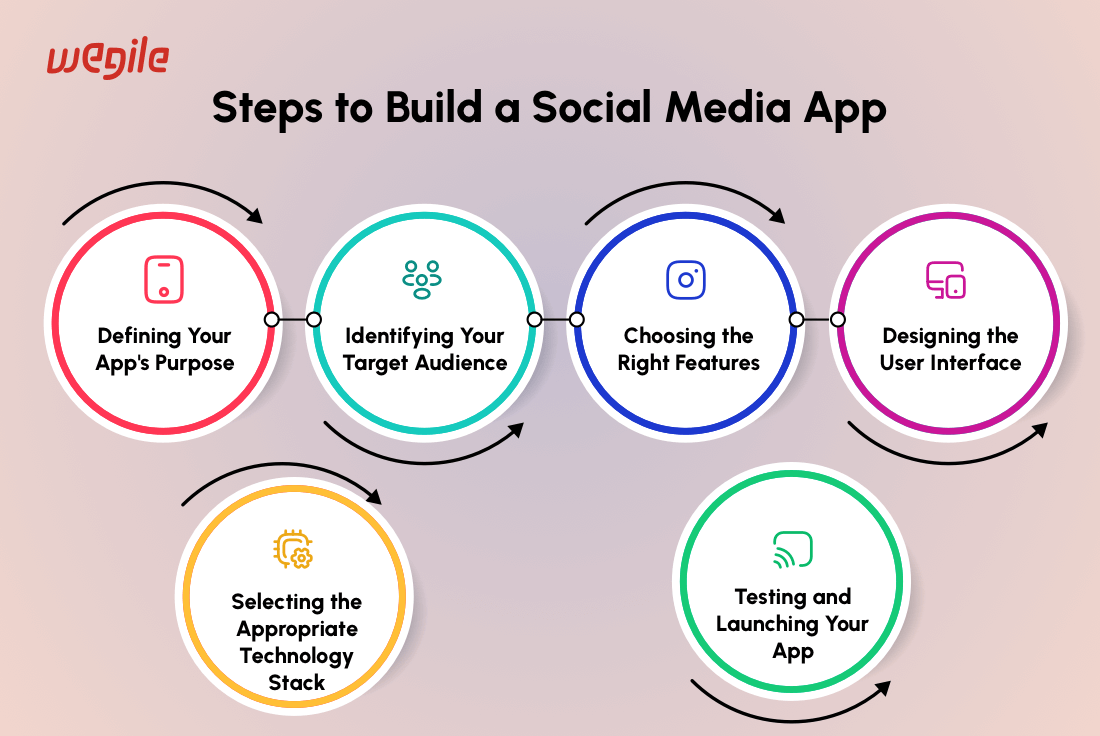
Steps to Build
a Social Media App
-
1. Defining Your App’s Purpose
In the initial phase of developing a social media app, articulating a clear and compelling
idea is paramount. This step transcends mere functionality; it’s about embedding your app
with a mission that resonates deeply with its intended users. Unlike traditional approaches
that often start with feature lists, innovative social media development begins with a
user-centric vision. This involves identifying a gap or a unique need within the social
media ecosystem that your app aims to fulfill. Whether it’s fostering niche communities,
promoting social change, or offering novel ways of interaction, the purpose of your app acts
as its guiding star. It informs design decisions, feature development, and marketing
strategies, ensuring that every aspect of the app aligns with the core mission, thereby
establishing a stronger connection with your target audience. -
2. Identifying Your Target Audience
Understanding your target audience is not just about demographics; it’s about diving deep
into the psyche of your potential users. It involves unraveling their behaviors,
preferences, challenges, and how they interact within digital communities. Innovative social
media app development leverages sophisticated data analytics and user research to create
detailed user personas. These personas then inform every aspect of the development process,
from the app’s design and features to its tone and content. For instance, if your app caters
to professionals seeking networking opportunities, features like in-depth profiles,
connectivity options, and professional group spaces become crucial. Tailoring your app to
meet the specific needs and desires of your target audience not only enhances user
engagement but also fosters a loyal user base, which is essential for the long-term success
of any social media platform. -
3. Choosing the Right Features
Selecting the right features for a social media app involves more than just integrating
trending functionalities; it’s about creating a unique ecosystem that enhances user
engagement and retention. Advanced social media development strategies focus on innovation
in feature selection, often incorporating AI to personalize user experiences and blockchain
for improving security and transparency. For instance, implementing AI-driven algorithms can
help deliver tailored content feeds, making each user’s experience unique and engaging.
Moreover, incorporating features that facilitate real-time interactions, such as live
streaming or instant messaging, can significantly boost user connectivity and community
feeling. The key is to balance innovative features with simplicity to ensure the app remains
accessible yet powerful, providing users with a seamless and enriching online social
experience. -
4. Designing the User Interface
A social media app’s user interface (UI) design is critical to shaping the user’s journey and
overall experience. Beyond aesthetics, an effective UI design is intuitive, making
navigation effortless for the users. In the realm of social media development, embracing
minimalism can lead to a more focused and user-friendly interface. This involves using clean
lines, coherent color schemes, and logical placements of elements to reduce cognitive load
and enhance usability. Additionally, incorporating inclusive design principles ensures the
app is accessible to a broader audience, including those with disabilities. This not only
expands the app’s user base but also demonstrates a commitment to creating an inclusive
digital community. The ultimate goal of UI design in social media apps is to create an
environment where users feel comfortable, engaged, and motivated to interact. -
5. Selecting the Appropriate Technology
StackChoosing
the right framework for social media app development is pivotal in the foundational
stage. It’s not just about current trends but selecting a stack that ensures scalability,
reliability, and real-time data processing capabilities essential for social media
platforms. Emerging trends in social media development suggest a shift towards more
adaptable and robust frameworks like Node.js for backend development, which offers the speed
and scalability needed for handling numerous simultaneous connections. On the front end,
React or Vue.js can provide a dynamic and responsive user interface, enhancing user
engagement. Additionally, incorporating cloud services like AWS or Google Cloud can offer
scalable storage solutions and ensure seamless performance across global user bases. This
strategic selection of technologies can significantly influence the app’s functionality,
user experience, and long-term viability in the competitive social media landscape. -
6. Testing and Launching Your App
The final phase before launching a social media app involves rigorous testing to ensure a
seamless user experience. This stage is crucial for identifying and rectifying any potential
issues that could affect functionality, security, or user satisfaction. A comprehensive
testing strategy should include unit testing, integration testing, and user acceptance
testing (UAT), each serving a unique purpose in validating the app’s performance and
usability. Moreover, employing beta testers can provide valuable real-user feedback,
offering insights that might not be apparent in a controlled testing environment. Once the
app has undergone thorough testing and refinements, the launch phase becomes a strategic
operation, involving a well-planned marketing campaign to generate buzz and attract initial
users. It’s also essential to have a feedback mechanism in place post-launch to continuously
improve and evolve the app based on user suggestions and technological advancements.
The
Strategic Advantage of Partnering with Experts
In the intricate journey of bringing a social media app from concept to launch,
partnering with a specialized social media app
development company offers a strategic advantage that can set your project apart. These
companies bring to the table a wealth of expertise, not just in the technical aspects of development
but also in understanding the nuanced dynamics of social media ecosystems. They are adept at
navigating the challenges unique to social media applications, such as ensuring user privacy,
creating engaging content algorithms, and building scalable infrastructures that can handle rapid
user growth.
Moreover, a specialized development partner can provide invaluable insights into emerging trends and
innovative features, helping your app stay ahead in a competitive landscape. Their experience in
similar projects means they are equipped with best practices for user engagement, retention
strategies, and monetization models that are proven to work. This collaboration not only enhances
the technical robustness of your app but also enriches the strategic vision, ensuring that the app
resonates with its intended audience and achieves its business objectives. In essence, the right
development partner transforms the app development journey into a collaborative venture towards
innovation and success.
Wrapping Up
The endeavor to create a social media app that captivates and retains users in the ever-evolving
digital landscape is both challenging and rewarding. As we’ve explored, it necessitates a deep
understanding of your app’s purpose, audience, and the innovative features that will define its
place in the market. Equally crucial is the design of an intuitive user interface and the selection
of a robust technology stack that ensures scalability and reliability. Remember, the journey doesn’t
end at launch; continuous testing, user feedback, and adaptation are key to sustained growth and
relevance.
For entrepreneurs poised to embark on this journey, the complexity of social media app development
underscores the value of partnering with a seasoned social media development company. Such a
partnership can provide not just technical expertise but strategic insights that are invaluable in
navigating the intricacies of the social media domain. In this context, Wegile stands out as a
partner equipped with the experience, skills, and vision to bring your social media app from concept
to reality, ensuring it is poised for success in the competitive digital ecosystem.
Leave a Reply