Social networking apps are at the forefront, consistently reshaping the ways we connect, share, and
engage with each other. At the core of this transformative journey is the rise of real-time
communication—a feature that has evolved from something of a luxury to a daily activity for users.
In addition to instant messaging, real-time communication encompasses a diverse range of live
interactions, including video streams that overcome geographical limitations and updates that follow
the fast-paced nature of everyday life. This article aims to explore the intricate details of
real-time communication within social networking platforms, investigating the deeper aspects that
influence user experiences beyond the surface-level advantages. In this blog, we will explore how
real-time communication molds our digital and interpersonal landscapes.
What is
Real-Time Communication?
Real-time communication (RTC) signifies a significant change in the way social interactions on the
Internet are conducted. RTC is centered around technologies that facilitate instant information
exchange, creating an environment where conversations and content sharing flow smoothly, similar to
in-person interactions. RTC goes beyond the usual digital interaction by eliminating the delay that
used to be an integral part of electronic exchanges. This sense of immediacy goes beyond mere speed.
It’s about fostering a synchronized atmosphere where users can actively participate in real-time
interactions, be it through text, voice, or video. The core of RTC is its capacity to harmonize user
experiences, rendering distances practically insignificant and revolutionizing our perception of
connectivity in the digital world.
The technology behind RTC involves an advanced collaboration of protocols and architectures, like WebRTC (Web Real-Time Communication). This
results in direct, peer-to-peer communication within web browsers, removing the need for
intermediaries or extra plugins. The widespread adoption of real-time capabilities in social media
apps is due to the accessibility of these features, which prioritize immediate interaction. In
addition, the continuous development of cloud infrastructure and edge computing has greatly
minimized latency, resulting in an even better real-time communication experience. Real-time
communication has completely transformed the way we engage on social platforms, establishing a fresh
comparison for instantaneity and interconnectedness.
Some of the popular sources of real-time communication in social media apps are:
-
1. Instant Messaging
Instant Messaging allows users to send text messages instantly back and forth. This tool
supports fast-paced, text-based communication, enhancing connectivity by allowing users to
exchange thoughts and information in real-time. -
2. Video Conferencing
Video conferring enables face-to-face interaction from virtually anywhere in the world. This
method is vital for personal conversations, business meetings, or virtual hangouts,
providing a sense of presence and personal touch despite physical distance. -
3. Live Streaming
With live streaming, users can broadcast video content in real-time, engaging with an
audience as events unfold. This method is particularly popular for live tutorials, gaming,
events, and more, allowing interaction through comments and reactions during the broadcast. -
4. Voice Calls
The voice calling feature in social media apps Facilitates real-time voice communication
between users. Similar to traditional phone calls but over the internet, this feature helps
maintain personal connections without the need for text-based messaging.
Understanding Half
Duplex and Full Duplex
In real-time communication within social media apps, understanding the concepts of half and full
duplex is crucial for optimizing interactions. Half-duplex communication allows data to travel in
both directions on a signal carrier but not at the same time. For instance, in a walkie-talkie-like
scenario within an app, a user must wait for the other to finish speaking before responding, making
it suitable for certain types of controlled communication environments where bandwidth is limited.
Conversely, full duplex communication supports simultaneous data transmission in both directions,
akin to a telephone conversation. This method is essential for live video conferencing or voice
calls on social media, where seamless, real-time interaction is paramount. The ability to transmit
and receive data simultaneously without waiting enhances the user experience by making digital
interactions feel as natural and fluid as in-person conversations. Full duplex systems are more
complex and require sophisticated management of signal paths and bandwidth to ensure clarity and
delay-free communications.
Technologies involved in Real Time Communication
| Technology | Description | Use Case |
| WebRTC | A free and open-source project that lets web browsers and mobile apps talk to each other in real time using simple APIs. |
Enables video and audio communication directly in the browser without the need for additional plugins or software. Commonly used for video chats and peer-to-peer sharing. |
| WebSocket | A protocol for establishing full-duplex communication channels through a solitary TCP connection. |
Used for continuous data exchange between a client and a server, ideal for chat applications and live sports updates where low latency is crucial. |
| SignalR | A library for ASP.NET developers that simplifies the process of adding real-time web functionality to applications. |
Facilitates real-time bi-directional communication between server and client, enabling features like live chat and real-time updates for collaborative applications. |
| MQTT | The lightweight messaging protocol offers a straightforward means for resource-constrained network clients to distribute telemetry information. |
Often implemented in mobile environments where bandwidth and battery power are at a premium, perfect for real-time IoT device updates. |
| XMPP (Jabber) | An open, extensible messaging and presence protocol designed for real-time communication. |
Supports messaging, presence information, and contact list maintenance, commonly used in the backend of many messaging services for instant communication. |
| SIP (Session Initiation Protocol) | A lightweight messaging protocol that facilitates the distribution of telemetry data for network consumers with limited resources. |
Commonly used for video conferencing and direct instant messaging connections, as well as controlling multimedia communication sessions. |
| Push Technology | A method of internet-based communication where the request for a transaction is initiated by the publisher or central server. |
Utilized for sending real-time notifications and updates to users’ devices, keeping them informed about new messages or events immediately. |
Benefits of Real-Time Communication in Social
Networking Apps
-
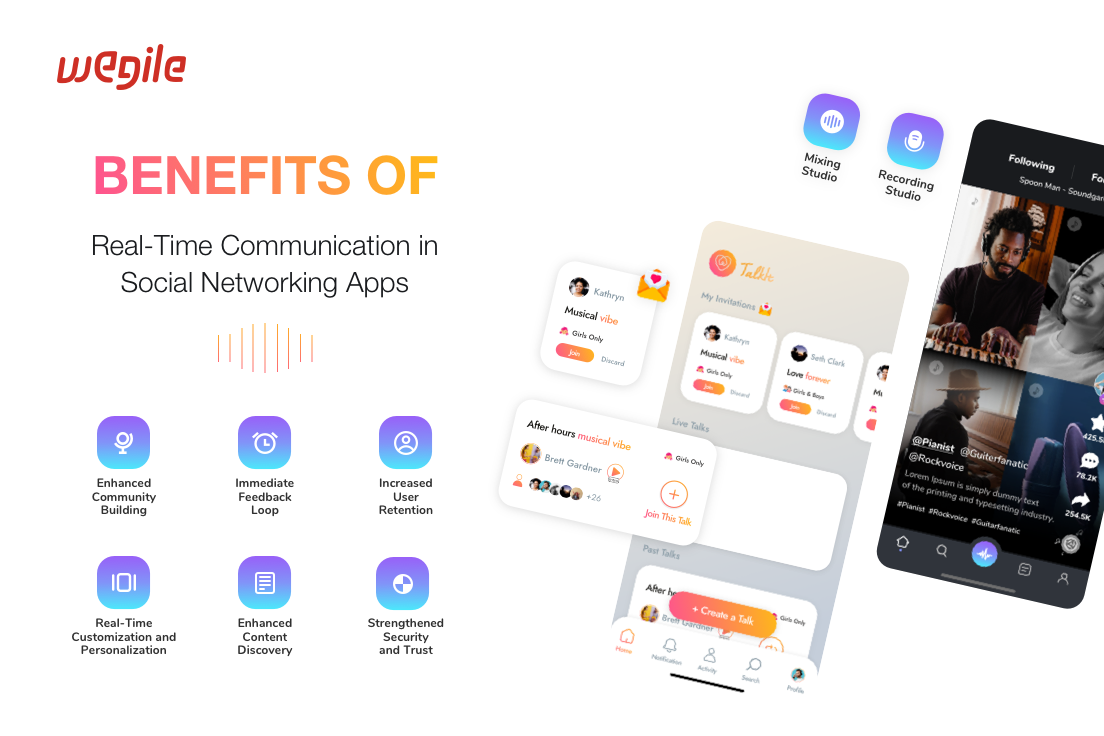
1. Enhanced Community Building
Real-time communication fosters a sense of belonging and community among users. In social
networking apps, features like group chats, live streaming, and real-time reactions enable
users to connect and engage over shared interests and events as they happen. This immediacy
creates a vibrant, dynamic community atmosphere that can’t be replicated through delayed
interactions. By participating in real-time discussions and events, users can form stronger
bonds and feel more integrated into the community, enhancing their overall experience and
loyalty to the platform. -
2. Immediate Feedback Loop
One of the key benefits of real-time communication is the creation of an immediate feedback
loop between users and content creators. Whether it’s comments on a post, reactions to a
live video, or responses in a chat, real-time interaction allows for instant engagement.
This further enriches the user experience by making it interactive and responsive and also
provides valuable insights for content creators and platform administrators. Understanding
user reactions and preferences in real time enables quicker adjustments and more targeted
content creation, leading to a more engaging and user-centric platform. -
3. Increased User Retention
Real-time communication capabilities are crucial for keeping users engaged and invested in a
social networking app. The instant nature of these interactions ensures that users are
continually drawn back to the platform, whether it’s for a quick chat, to check on updates
from their network, or to participate in live events. This constant engagement helps to
significantly reduce churn rates as users find more value and utility in the platform,
making it an integral part of their daily routines. This results in a loyal user base that
sustains the platform and contributes to its growth through increased activity and new user
referrals. -
4. Real-Time Customization and
PersonalizationReal-time communication enables platforms to offer highly customized and personalized user
experiences. By analyzing user interactions and preferences in real-time, social networking
apps can dynamically adjust content, recommendations, and notifications to suit individual
user needs. This level of personalization enhances user satisfaction, as the content feels
more relevant and engaging, encouraging further interaction with the app. Personalized
real-time alerts about friend activities, events, or topics of interest ensure that users
are always connected to what matters most to them, making the social networking experience
deeply integrated into their personal and social lives. -
5. Enhanced Content Discovery
The integration of real-time communication in social networking apps significantly improves
content discovery mechanisms. Live feeds, trending topics, and real-time recommendations
keep the content landscape fresh and engaging. Users are more likely to encounter new
content that resonates with their interests, leading to increased exploration within the
app. This not only enriches the user experience but also provides content creators and
advertisers with a more dynamic and responsive platform for content distribution and
engagement, boosting visibility and interaction rates for new and relevant content. -
6. Strengthened Security and Trust
In the context of social networking, real-time communication can also play a pivotal role in
enhancing security and building trust among users. Real-time alerts and notifications about
account activity, such as new logins or changes to account settings, can help users quickly
detect and respond to unauthorized access or potential security threats. Additionally, the
ability to report and receive immediate support or feedback on issues related to content or
interactions within the app strengthens the trust users have in the platform’s commitment to
their safety and well-being. This immediate support and responsiveness are crucial for
maintaining a secure and trustworthy environment, which is essential for user retention and
the platform’s reputation.
Challenges of Real-Time Communication in Social
Networking Apps
-
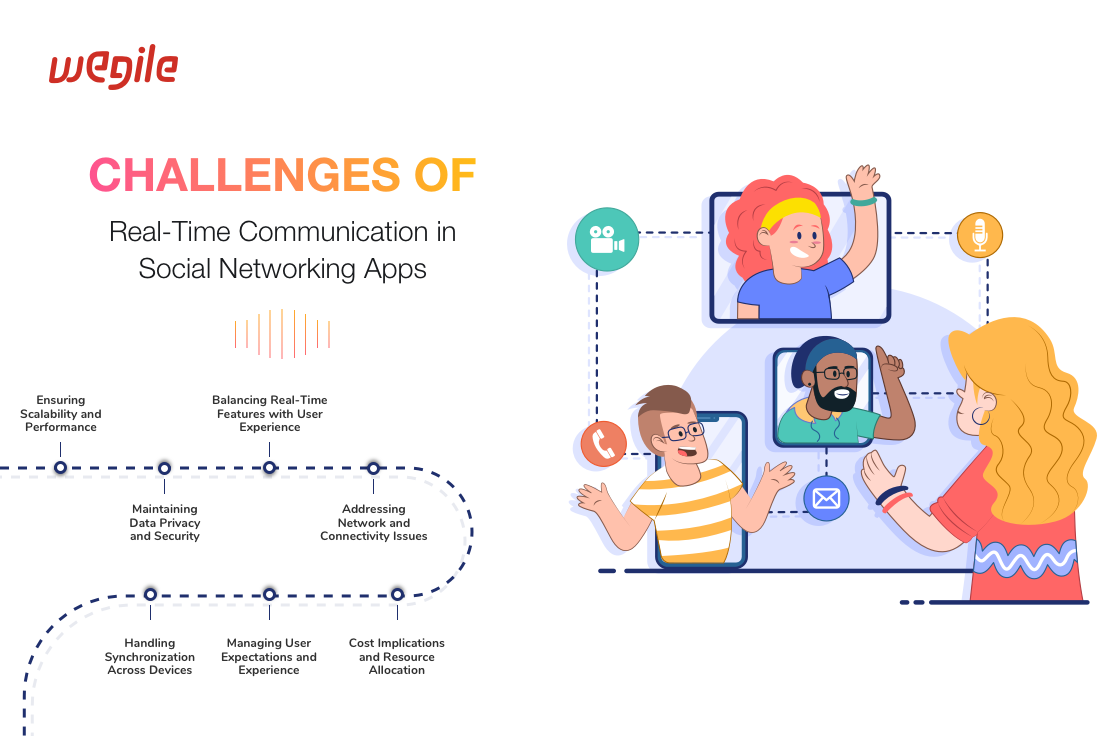
1. Ensuring Scalability and Performance
One of the paramount challenges in implementing real-time communication features in social
networking apps is ensuring scalability and performance. As the user base grows, the
infrastructure must efficiently manage an increasing volume of simultaneous real-time
interactions without lag or downtime. This requires robust backend architecture and
innovative solutions like load balancing, efficient data handling, and choosing
the right framework for social media apps to maintain smooth and responsive
communication channels, even during peak usage times. -
2. Maintaining Data Privacy and Security
Integrating real-time communication raises significant concerns about data privacy and
security. Each message, video call, or shared update increases the risk of data breaches and
unauthorized access. Social networking apps must implement stringent security measures, such
as end-to-end encryption for messages and calls, secure data storage practices, and regular
security audits to protect user information. Additionally, compliance with international
data protection regulations, like GDPR, adds another
layer of complexity, requiring constant vigilance and updates to privacy policies and
security protocols. -
3. Balancing Real-Time Features with
User ExperienceWhile real-time communication enhances user engagement, it also poses the challenge of
integrating these features without cluttering the app interface or overwhelming users with
notifications. Designing an intuitive user interface that seamlessly incorporates real-time
interactions, such as chat windows, live video streams, and notifications, requires a deep
understanding of user behavior and preferences. The aim is to offer a clean, user-friendly
experience that makes real-time features accessible and enjoyable without detracting from
the overall usability of the app. -
4. Addressing Network and Connectivity
IssuesReal-time communication heavily relies on stable and fast internet connectivity. Users in
areas with poor network coverage or those using low-bandwidth connections may experience
delays, interruptions, or lower-quality interactions. Social networking apps need to
optimize real-time communication features to function effectively across varying network
conditions, possibly incorporating adaptive bitrates for live streaming or offline
capabilities for messaging to ensure that all users can participate in real-time
interactions regardless of their connectivity situation. -
5. Handling Synchronization Across
DevicesEnsuring that real-time communication is synchronized across multiple devices poses a
significant technical challenge. Users often switch between smartphones, tablets, and
desktops, expecting seamless transition and continuity in their communication. Achieving
this requires sophisticated synchronization mechanisms that can handle real-time data across
diverse platforms and operating systems, ensuring that messages, notifications, and content
updates are consistently reflected, no matter the device in use. -
6. Managing User Expectations and
ExperienceThe integration of real-time communication features comes with heightened user expectations
for instant gratification and uninterrupted service. Any delay, be it in message delivery,
notification updates, or live streaming, can significantly impact user satisfaction. Meeting
these expectations requires not just robust technical infrastructure but also effective user
experience design that can gracefully handle potential issues like server latency or
downtime, ensuring that user experience remains positive even when technical challenges
arise. -
7. Cost Implications and Resource
AllocationImplementing and maintaining real-time communication features can be resource-intensive,
leading to increased operational costs. These costs stem from the need for high-performance
servers, data transfer expenses, development and maintenance of the communication
infrastructure, and compliance with security and privacy standards. Balancing the financial
investment against the value added to the user experience is a crucial challenge, requiring
careful planning and optimization to ensure that the benefits of real-time communication
justify the costs involved.
Future Landscape
of Real-Time Communication
The future landscape of real-time communication in social media apps is poised for transformative
growth, driven by advancements in AI and machine learning. Enhanced predictive analytics will
improve the personalization of interactions, making them more contextually relevant and timely.
Integration of 5G technology will further reduce latency, facilitating smoother, more reliable
communication experiences akin to real-world conversations.
Also, as AR and VR technologies mature, we’ll see more immersive communication environments that
replicate physical presence, offering users novel ways to connect and engage. The blend of these
technologies will not only redefine user expectations but also elevate the standards of interaction,
making real-time communication more intuitive, seamless, and engaging.
How Can
Wegile Help You With Real-Time Communication?
At Wegile, we understand the intricacies and challenges of integrating real-time communication into
social networking apps. Our expertise in developing cutting-edge social media applications positions
us as your ideal partner in this journey. We specialize in crafting solutions that are not only
technologically advanced but also deeply attuned to the needs of your users, enhancing engagement
and fostering a vibrant community.
Our approach involves a meticulous analysis of your specific requirements and the unique dynamics of
your target audience. This ensures that the solutions we provide are tailor-made to fit your
objectives, whether it’s scaling to accommodate a growing user base, implementing robust security
measures to protect user data, or delivering a seamless user experience that keeps your audience
coming back for more.
With our social media
app development company‘, you’re not just getting a service provider; you’re partnering with
a team that’s committed to your success. We bring to the table a wealth of experience, a commitment
to excellence, and a deep understanding of the social networking domain, ensuring that your app not
only meets the current standards but also sets new benchmarks in user engagement and satisfaction.
Wrapping Up
In conclusion, real-time communication is not just a feature but the backbone of user engagement and
interaction in social networking apps. Its ability to connect users instantly, foster community
building, and deliver personalized content makes it indispensable in today’s digital age. However,
integrating these features comes with its set of challenges, from ensuring scalability to
maintaining privacy and security. At Wegile, we are dedicated to navigating these complexities,
offering tailored solutions that enhance user experience and engagement. By partnering with us, you
leverage our expertise to create a social networking app that not only meets but exceeds user
expectations, setting new standards in the digital landscape.
Leave a Reply