In today’s interconnected world, real-time messaging in social media apps has become an integral part
of our daily communication. Gone are the days when delayed responses were normal; today people crave
instant communication and uninterrupted connectivity. This transformation is driven by the rapid
advancement of technology and the inherent desire for instant acknowledgment and connection.
Interestingly, while many discussions in the tech sphere revolve around the technical skills
required to facilitate such features, there’s hardly detailed information on the strategic
considerations of integrating real-time messaging into social media apps. In this blog, we will
delve into the process of incorporating real-time messaging into social media apps.
Importance of Real-Time Messaging in Social Media
Apps
Real-time messaging has become a crucial element of social media apps today, bringing people closer
together and facilitating instant connections that were previously unimaginable. This feature goes
beyond mere convenience; it has become a fundamental expectation among users.
The significance of this instantaneity cannot be overstated; it goes above the quick exchange of
messages and instead focuses on the needs of a vibrant, lively community that thrives on prompt
feedback and interaction. This immediacy reflects the natural flow of human conversation, creating a
feeling of closeness and connection in digital interactions that many platforms strive to achieve.
However, the true essence of real-time messaging in social media apps goes far past the technical
obstacles it poses. Its strength lies in its ability to create a sense of connection and belonging
in the digital realm, ensuring every user feels acknowledged and connected, regardless of the
physical barriers. This aspect is often overlooked due to the technical complexities of
implementation. However, it is essential to understand the significance of real-time messaging in
today’s digital communication landscape if you want to stay ahead!
Challenges in
Implementing Real-Time Messaging
-
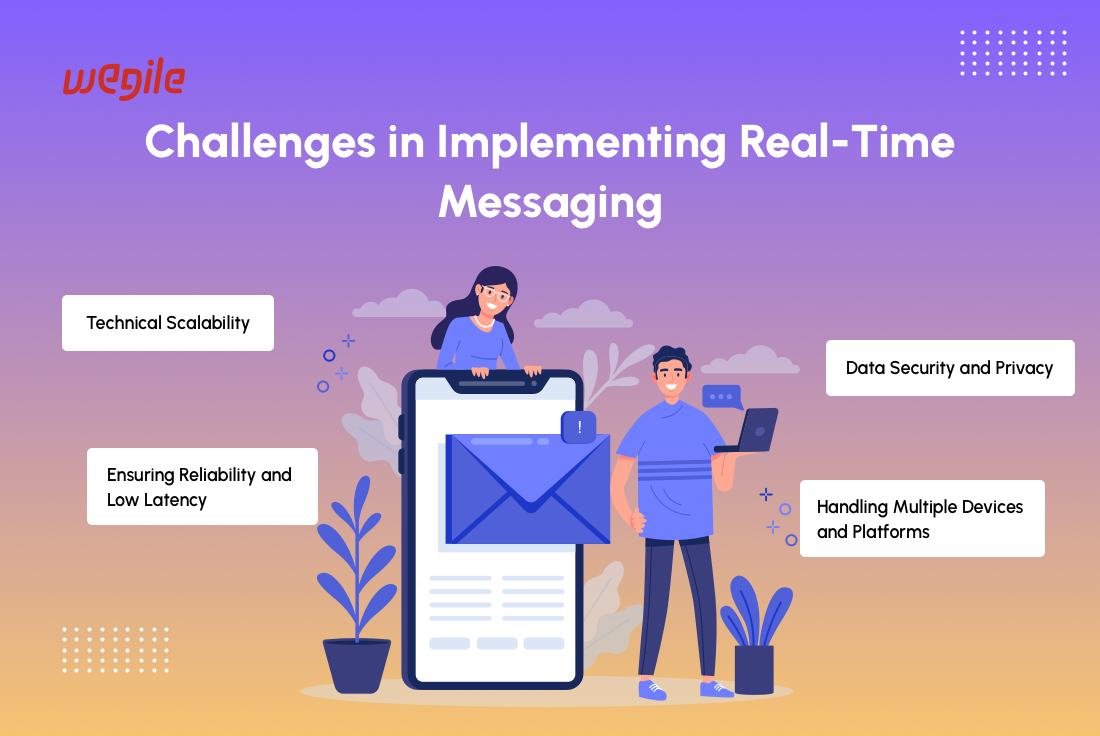
1. Technical Scalability
One of the critical challenges in successfully implementing real-time messaging within social
media apps is ensuring technical scalability. As user bases expand rapidly, the app’s
infrastructure must keep up with the current demands and proactively plan for future growth.
This requires advanced architectural planning where both hardware and software components
are fine-tuned for maximum efficiency. Techniques such as load balancing, database sharding,
and the adoption of microservices
architecture become crucial. These strategies guarantee that when there is a sudden
spike in the number of users, the system can handle the increased load without impacting
performance or reliability. -
2. Data Security and Privacy
In real-time messaging, ensuring data security and privacy is of utmost importance, and it
goes above the usual encryption practices. With users sharing sensitive information in what
they perceive as private conversations, the responsibility on social media apps is immense.
Advanced security measures, like end-to-end encryption, are no longer just optional features
but essential requirements.However, the discussion often misses the nuanced challenges, like metadata
privacy, which refers to safeguarding non-content data linked to online activities,
including IP addresses, timestamps, and location information. Even when message contents
have been encrypted, data about the sender, recipient, and timing can still provide
revealing insights. Implementing robust security while maintaining user privacy, especially
in a real-time setting, requires a careful balance that respects user trust and regulatory
requirements.Also
Read: 8
Social Media App Development
Strategies For Success -
3. Ensuring Reliability and Low Latency
Attaining reliability and low latency in real-time messaging can be a complex task that
requires attention. Ensuring prompt and uninterrupted message delivery is crucial for
meeting user expectations and ensuring their satisfaction. This requires a sophisticated
backend infrastructure that efficiently handles large amounts of traffic. Utilizing
innovative approaches like memory data stores for rapid access and employing efficient
routing algorithms are critical. These technical strategies guarantee the reliable delivery
of messages with minimal latency, creating a communication experience that closely resembles
natural face-to-face interactions. -
4. Handling Multiple Devices and
PlatformsReal-time messaging spans a wide range of devices and platforms, each with its own
specifications and limitations. Developing a messaging solution that delivers reliable
performance across a wide range of hardware and operating systems is a difficult task. This
challenge necessitates thoroughly optimizing messaging protocols, data transmission methods,
and user interface designs to guarantee that real-time interactions stay smooth and
responsive, highlighting the significance of efficiency and performance. In addition,
customizing messaging protocols and compression algorithms to accommodate various device
capabilities while maintaining a high level of service has proven to be successful.
Solutions For
Implementing Real-Time Messaging
-
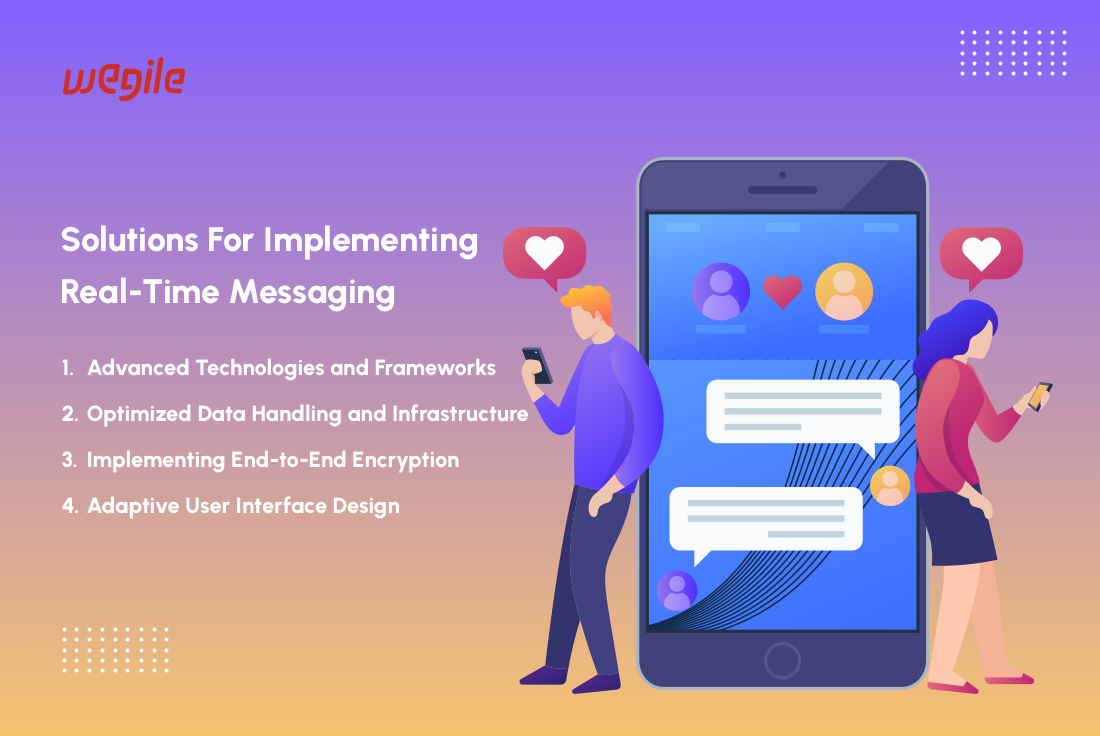
1. Advanced Technologies and Frameworks
The integration of cutting-edge technologies and frameworks is crucial in addressing the
obstacles of real-time messaging. One possible solution involves the use of WebSocket
technology. This technology enables a two-way communication channel that remains open for a
long time, allowing data to be exchanged quickly and seamlessly between the client and
server. In addition, the incorporation of WebRTC (Web Real-Time Communication) allows for
direct communication between peers, resulting in decreased server load and latency.
Implementing these technologies requires a deep understanding of their mechanisms and the
skill to customize them to meet the unique requirements of social media applications,
guaranteeing scalability, reliability, and real-time responsiveness. -
2. Optimized Data Handling and
InfrastructureStreamlined data management and a strong infrastructure form the basis for a smooth real-time
messaging experience. Techniques such as data
compression and binary
data transmission can significantly reduce latency and bandwidth usage, making messaging
more efficient even in low-bandwidth scenarios. When it comes to infrastructure, utilizing
cloud services and Content Delivery Networks (CDNs) can offer the scalability needed to
manage unexpected surges in traffic. Furthermore, employing microservices architecture, as
we discussed earlier, can enhance the system’s ability to scale dynamically and facilitate
faster feature deployment, which is crucial for maintaining a competitive edge in the
rapidly evolving social media landscape.Also Read:
Revolutionizing Social Apps
with Real-Time Communication -
3. Implementing End-to-End Encryption
Securing real-time messaging in social apps takes into consideration more than traditional
security measures. It involves the use of end-to-end encryption (E2EE) to guarantee that
only the intended users can read the messages. This approach prioritizes user privacy and
fosters trust in the platform. Implementing advanced encryption protocols, such as Signal
Protocol, can provide the necessary security and a smooth user experience crucial for social
media applications. However, the challenge lies in seamlessly incorporating E2EE into the
app without compromising the app’s performance or usability, necessitating innovative
solutions that balance security with user experience. -
4. Adaptive User Interface Design
A user-centric approach to real-time messaging involves creating adaptive and intuitive
interfaces that cater to diverse user needs and preferences. This involves creating designs
that are accessible to all users, ensuring that messaging features are usable by people with
disabilities, and optimizing for various devices and screen sizes. Employing responsive
design principles and testing across various devices can ensure a consistent and engaging
user experience. Additionally, incorporating user feedback into the design process can lead
to continuous improvement and innovation in the messaging interface, ensuring it aligns with
user expectations and current trends in social media communication.
Wrapping Up
The essence of real-time messaging in social media apps transcends mere instant communication; it’s
about forging genuine connections in the digital realm. The journey from concept to implementation
is filled with challenges, from ensuring scalability and security to crafting an intuitive user
experience.
These challenges require much more than technical expertise; they require a deep understanding of
user needs and behaviors. At Wegile, we pride ourselves on being leaders in developing social media
apps that fulfill the current demands for real-time messaging and establish new standards for user
involvement and satisfaction.
As a leading social
media app development company, our expertise lies in navigating the complexities of app
development, ensuring that every feature we incorporate enhances the user’s digital interaction. If
you’re envisioning a social media app that stands out for its seamless communication and
user-centric design, Wegile is your ideal partner. Together, we can transform your vision into a
thriving online community.
Leave a Reply