Future Trends Of Wearables
Wearable technology revolutionizes our personal well-being and lifestyle, allowing us to access
unprecedented levels of data about ourselves. From fitness trackers that help you reach your goals
to smart glasses with countless lenses for a unique style statement, wearable devices are changing
the way we think about technology in everyday life. As innovations become miniaturized and powerful
computational abilities fit into increasingly compact packages, wearables extend beyond mere
convenience — they can be meaningful catalysts for transformation.
With this blooming industry comes an exciting set of future trends of wearables rising above all
others: fashion-forward designs, better screens through folding displays or curved glass interfaces,
augmented reality experiences, and much more! Let us take a look at the forecast for wearable
technology and the future of wearable technology.
List Of Future Trends Of Wearables
-
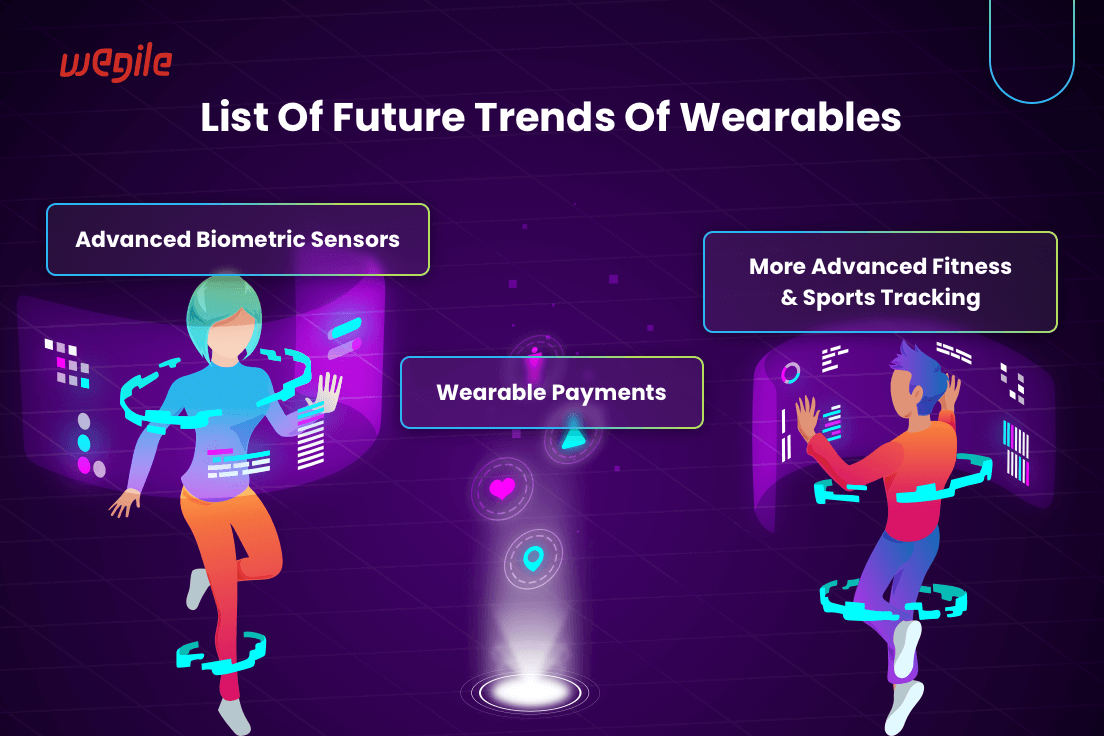
1. Advanced Biometric Sensors
The future of wearables lies in advanced biometric sensors. Wearable technology with these
sensors will allow people to capture comprehensive readings on vital signs – including heart
rate, VO2 max, respiration rates, and skin temperature. By leveraging the power of
artificial intelligence (AI) to process big data from different sources quickly, the
insights gathered can provide personalized health recommendations that go beyond just
diagnostics.As AI continues advancing, we’ll be able to see even more complex correlations between our
behaviors and physiological states, which could lead us towards preventative healthcare
options for conditions like diabetes or cardiovascular diseases earlier than ever before! -
2. More Advanced Fitness and Sports Tracking
Wearable technology has long had the capability to monitor vital signs such as heart rate and
sleep cycle, but now forecasts for wearable technology suggest more advanced in their
tracking of fitness activities. From golf swings to weight lifting sets, virtual coaches can
provide personalized data points that enable athletes to fine-tune their performance.Furthermore, they can track a multitude of biometrics simultaneously, giving immediate
feedback on fatigue levels and muscle activity during intense workouts or competitions. By
having access to real-time analytics that measure both muscles involved in an exercise as
well impact forces related to biomechanics, players will be able to gain improved insight
into ways for further progression, enabling them to stay healthier longer while pushing
boundaries further than before possible with current standard programs available today.Check out 7 Best Wearable Apps For Productivity And Efficiency
-
3. Wearable Payments
The next big trend in wearables is wearable payments. Urban dwellers aiming to lighten their
load are increasingly ditching wallets and other bulky items for the convenience of
wrist-worn mobile payment technology. Devices like Apple Watches, Wear OS watches, and smart
jewellery provide consumers with a seamless way to pay for goods and services without ever
having to pull out cash or cards – it simply requires a tap at a reader enabled by
near-field communication (NFC). The future of wearable technology indeed lies in your hands! -
4. Smart Clothing
Wearable technology is becoming increasingly sophisticated, and designers have begun to
explore ways of seamlessly incorporating smart features into everyday clothing. Sensors are
being woven into fabrics that can track a user’s motions and vital signs as they move or
exercise; illuminated jackets respond directly to the wearer’s body language – glowing
brighter when excited, for instance.
The Future Of Wearable App
Development
As developers of wearable applications, we stand poised on the cusp of an exhilarating technological
revolution. Advances in artificial intelligence, machine learning, and pioneering technologies are
driving unprecedented advances in how humans connect with their devices, spawning a world of new
possibilities for wearable app development.
Whether it be medical and fitness technologies, navigation, remote asset tracking, or other areas,
the potential of these tiny computers appears to be boundless. Ride the wave of innovation—the
future of wearable app development has never been more exciting!
Future Of Wearable Technology
– List
-
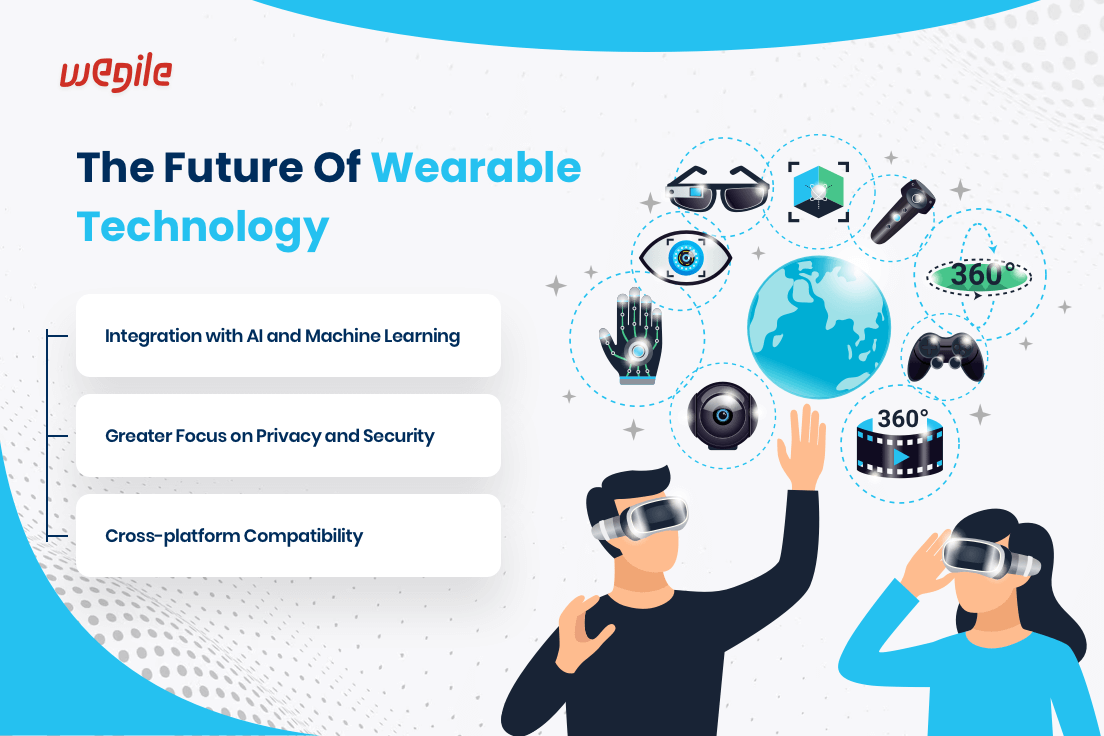
1. Integration with AI and Machine Learning
The Future of Wearable Technology is Integrating AI and Machine Learning. One key trend that
looks set to revolutionize wearables in the near future is machine learning and artificial
intelligence integration. By leveraging eML algorithms, these technologies can help augment
human abilities―ranging from strong task analysis capabilities for enhanced productivity all
the way to medical monitoring devices capable of alerting individuals when their health
presents potential risks or problems.Integration with AI also opens up new doors on interoperability between systems where each
device becomes aware of its utility (and limitations) intra-operatively while dynamically
adapting as part of data processing networks. In short – modern wearables are quickly moving
towards a fully connected “internet-of-things” approach underpinned by ML/AI technologies
designed to improve user experience through detailed contextual knowledge interpretation. -
2. Greater Focus on Privacy and Security:
As wearable technology advances, there is also greater awareness of the need for privacy and
security. With more data being collected—from geolocation to personal health metrics—it’s
essential that developers prioritize user safety in their products. This involves
implementing secure authentication systems with encryption protocols on all devices, as well
as providing better transparency about what information will be shared by each tech supplier
or brand.Companies should strive towards adhering to strict consent laws when it comes to handing over
data such as biometrics; going further still would involve giving users a say in how any
third-party apps can access private info via an app permissions system comparable with those
seen with existing mobile operating systems – protecting customer’s interests without
impeding device functionality. -
3. Cross-platform Compatibility
Cross-platform compatibility is essential for the future of wearable technology. Platforms must be built
to
allow communication between different wearables, regardless if they come from Apple, Samsung,
or another manufacturer, in order to foster collaboration and real progress within this
burgeoning sector. As more technologies become available throughout various markets and
industries, it’s also useful when these devices can connect with each other – not only
enhancing productivity by allowing data sharing but also preventing vendor lock-ins which
might otherwise limit market opportunity.Ultimately enabled through emerging frameworks such as Bluetooth Low Energy (BLE)
transmission protocol, many leading players are looking towards leveraging cross-platform
functionality into their products moving forward; some have even started building
proprietary hardware dedicated exclusively to increasing interconnectivity potential across
diverse developer ecosystems.
Conclusion
We’ve all heard about the amazing capabilities and current and future trends of wearables—but what
does it mean for the future of wearable app development? With this forecast, we’re looking ahead to
bright possibilities. Wearable tech provides an opportunity to come up with apps that provide
benefits, such as helping users save time or money by linking them together.
As wearable technology continues its evolution into becoming an even more powerful driver in our
daily lives, there are infinite opportunities just waiting to be discovered. So why wait? Get ready!
The future promises big things for those who embrace these changes in the world of wearable
technology development. Hire Wegile for your wearable app development and be a part of a movement
towards a smarter and faster way of life with exciting new technologies here today and beyond!
Leave a Reply