The evolution of wearable technology from a niche market to an integral part of daily life has
significantly influenced the app development landscape. Initially limited to simple functions,
wearables have diversified into sophisticated devices such as fitness trackers and smartwatches,
each more advanced than the last.
This technological progression has catalyzed a paradigm shift for app developers. According to a
report by Precedence
Research, the wearable technology market is expected to grow at a compound annual growth
rate (CAGR) of 13.60% between 2023 and 2032, highlighting the growing importance of innovative app
integration. Given wearables’ intimate role in our daily routines, applications must prioritize ease
of use, seamless integration into daily life, and personalization.
As we delve into the implications of wearable technology on app development, it becomes clear that
this shift extends beyond mere programming languages and development tools. It’s about forging a
deeper connection between humans and technology. This article aims to elucidate not only the
practical aspects of developing wearables but also the underlying principles that make these
applications resonate on a personal level, providing a comprehensive overview of this rapidly
expanding field.
The
Advent and Growth of Wearable Technology
Wearable technology has undergone a remarkable transformation since its inception. Initially
characterized by cumbersome devices with limited functionality, wearables have now become integral
to our daily routines, enhancing both productivity and leisure. Early wearable devices were designed
for specific, basic tasks, lacking the broad utility and connectivity that define modern wearables.
During its inception, experimentation was prevalent, laying the groundwork for present-day diversity
in applications, especially within the health, fitness, and communication sectors.
Today, wearables extend beyond mere gadgets; they are seamlessly woven into the fabric of our daily
lives, offering functionalities that transcend basic activity tracking or notifications. They have
evolved to express personal style, promote wellness, and provide discreet monitoring. This evolution
has significantly influenced app development, necessitating user-friendly, engaging applications.
The development of wearables demands innovative thinking, prioritizing simplicity and efficiency in
user interaction.
Moreover, the versatility of wearables has fostered a plethora of app categories, ranging from mental
health and sleep improvement to language learning and navigation. This diversity opens expansive
avenues for developers to innovate and carve niches within the wearable ecosystem. In essence, the
journey of wearable technology is one of continuous evolution, presenting both opportunities and
challenges for app developers to push the boundaries of creativity. For those interested in the
trajectory of wearable technology, exploring the future of wearable app
development is both intriguing and essential.
Impact on App
Development
The advent of wearable technology has ushered in a new era for app development, compelling developers
to innovate in several key areas:
-
1. Smart and Personalized Experiences
Wearable apps are expected to be intuitive and responsive to the user’s immediate context and
activities. For instance, an app should be capable of presenting relevant metrics, such as
heart rate or distance during a run, tailored to the moment’s needs. This level of
personalization demands advanced algorithms and user-centric design to deliver the right
information at the right time. -
2. Efficient Battery Usage
Given the compact size of wearables and their limited battery capacity, efficiency is
paramount. Developers are tasked with optimizing app performance to ensure minimal power
consumption without compromising functionality, a challenge that requires ingenious coding
and resource management. -
3. Data Privacy and Security
With wearables tracking sensitive personal data, such as physical activity and health
metrics, security becomes a critical concern. Developers must implement robust encryption
and data protection measures to safeguard user privacy, a responsibility that’s becoming
increasingly complex in the face of sophisticated cyber threats. -
4. Seamless Device Integration
Wearable apps often operate in conjunction with smartphones and other connected devices,
necessitating seamless interoperability. Developers need to ensure that apps can communicate
effectively across devices, providing a cohesive user experience that bridges multiple
platforms. -
5. Innovative Interaction Methods
The compact nature of wearable devices limits the feasibility of traditional input methods
like tapping and swiping. This constraint has sparked creativity among developers, leading
to the exploration of alternative interfaces such as voice commands, gesture recognition,
and haptic feedback.
Hence, the rise of wearable technology is challenging app developers to rethink the fundamentals of
app design and functionality. From crafting personalized user experiences to pioneering new forms of
interaction, the shift towards wearables is driving a wave of innovation in the app development
space, setting new standards for what apps can achieve.
Wearable
App Development Technologies
Creating apps for wearables is an exciting venture, blending a variety of cutting-edge
technologies. Let’s explore the essential tools and technologies that enable developers to bring
their innovative ideas to life on wearable devices.
-
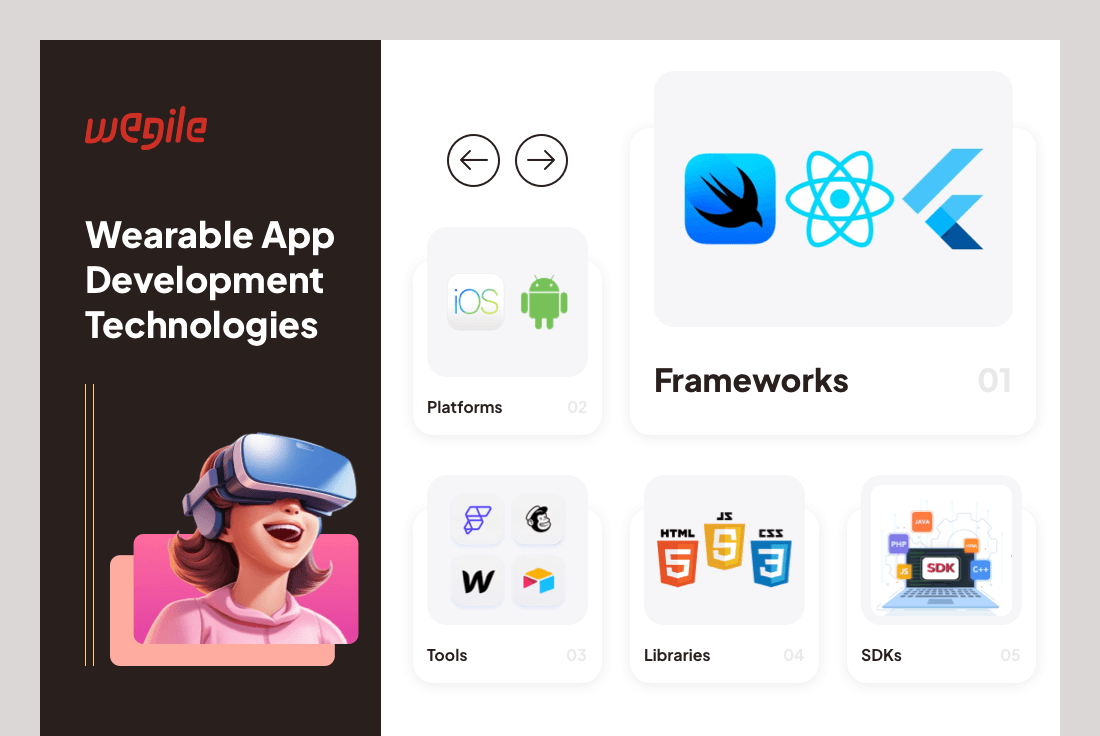
1. Frameworks
Frameworks serve as the foundational building blocks for app development, providing a
structured environment where apps can be designed, developed, and deployed. For wearables,
these frameworks must be efficient and lightweight to ensure smooth operation without
excessive battery drain. Popular choices include React Native, Flutter, Xamarin, and Ionic,
each offering unique benefits and capabilities suited to different types of wearable
applications. -
2. Platforms
Platforms act as the ecosystem within which apps are developed, tested, and released. They
can cater to a broad range of wearables or be tailored to specific devices, such as
smartwatches. Continuous updates to these platforms accommodate new features and devices,
fostering innovation. Leading platforms in this space include Android Wear OS, Apple
watchOS, Samsung Tizen for Wearables, Fitbit OS, and Garmin Connect IQ. -
3. Tools
Development tools are indispensable for developers, encompassing everything from integrated
development environments (IDEs) to bug detection utilities. These tools streamline the
development process, enhancing productivity and reducing the likelihood of errors. Key tools
in the wearable app development toolkit include Android Studio, Xcode, Visual Studio Code,
Eclipse, and Unity (particularly useful for AR/VR wearable applications). -
4. Libraries
Libraries offer a repository of pre-written code snippets, allowing developers to incorporate
sophisticated features into their apps without starting from scratch. This can significantly
accelerate development time and ensure higher performance and reliability. Noteworthy
libraries for wearable app development encompass TensorFlow Lite (for machine learning),
D3.js (for data visualizations), Retrofit (for Android network operations), SwiftCharts (for
iOS charting), and Hammer.js (for touch gesture recognition). -
5. SDKs
Software Development Kits (SDKs) are comprehensive packages that provide developers with an
array of tools, libraries, and documentation specific to a platform or device. SDKs enable
developers to fully leverage the unique capabilities of wearables, such as sensors and
specialized displays, facilitating the creation of deeply integrated and feature-rich
applications. Prominent SDKs in the wearable domain include Google Fit SDK, Apple HealthKit,
Samsung Accessory SDK, Qualcomm Vuforia (for augmented reality), and Oculus SDK (for virtual
reality).The technological landscape for wearable app development is rich and diverse, offering
developers a wealth of resources to craft engaging, innovative, and user-friendly
applications. As this technology continues to evolve, it promises to unlock new
possibilities for enhancing wearable devices, making them even more integral to our daily
lives. Engaging with a wearable
app development company can further amplify these possibilities, driving the creation of
captivating and advanced user experiences.
The Benefits of
Wearable Apps
Wearable apps truly stand out for their ability to seamlessly integrate into our lives, offering a
range of benefits that go beyond basic functionalities like step counting and notifications. Here’s
a closer look at what sets them apart:
-
1. Always Watching Over Your Health
Wearable apps serve as vigilant health guardians, constantly monitoring vital signs such as
heart rate, sleep quality, and stress levels. This continuous health tracking offers a
significant advantage, potentially alerting you against health issues before they escalate,
thereby promoting early intervention and more proactive health management compared to
traditional health monitoring methods. -
2. Keeping You Safe
Safety is a paramount feature of wearable apps. They possess the ability to detect falls,
send emergency notifications, and share your location with trusted contacts. This
functionality is especially beneficial for the elderly or individuals with specific health
conditions, providing peace of mind for both users and their loved ones. -
3. Fitting Into Your Day Easily
Wearable apps are designed for convenience, delivering timely reminders and updates directly
to your wrist, eliminating the need to check your smartphone constantly. This seamless
integration into daily routines allows for a more intuitive and less intrusive way to stay
organized and informed. -
4. All About You
The personalization aspect of wearable apps is truly remarkable. These apps adapt to your
preferences and needs, offering tailored recommendations ranging from fitness plans to
nutritional advice. This level of customization enhances the user experience by making
interactions more relevant and helpful. -
5. Helping You Change Habits
Wearable apps provide valuable insights into your behavior patterns by meticulously tracking
your daily activities and habits. Armed with this information, you can identify areas for
improvement, set realistic goals, and make informed decisions to enhance your productivity,
physical health, and mental well-being. -
6. Stay Connected Without the
DistractionWearable apps keep you connected to essential information without the overwhelming
distraction often associated with smartphones. By filtering and delivering only the most
pertinent notifications, they ensure you remain informed without compromising your focus or
engagement with the real world.
The
Future of Wearable App Development
The future of wearable app development is poised for groundbreaking innovations that will redefine
our interaction with technology. Here’s a glimpse into the exciting possibilities ahead:
-
1. Smart and Learning Apps
The next wave of wearable apps will leverage Artificial Intelligence (AI) to transcend basic
tracking functionalities, evolving into intelligent systems that adapt and learn from user
behavior. These smart apps will offer unprecedented personalization, providing insights and
recommendations tailored to individual needs and preferences, thereby enhancing the user
experience to new levels of convenience and relevance. -
2. Mixing Reality with Apps
Augmented Reality (AR) integration stands to revolutionize the wearable experience, merging
the digital and physical worlds in real time. Imagine wearable devices that can overlay
digital information onto the real world, such as displaying detailed product information or
navigation cues directly in your line of sight, effectively turning wearables into
interactive guides and assistants. -
3. Keeping an Eye on Health in New Ways
Upcoming wearables in the future will likely delve deeper into health monitoring, extending
beyond conventional metrics to include comprehensive analyses like neural activity,
nutritional absorption, and even genetic markers. This could usher in a new era of
personalized medicine and health optimization, offering insights far beyond what current
wearables can provide. -
4. Easier Ways to Use Them
Ease of use will be a central focus, with advancements aimed at making wearables more
intuitive. Innovations might include gesture-based controls or brain-computer interfaces
(BCIs), where wearables respond to neural commands or subtle movements, making the user
experience as seamless as thinking or moving a finger. -
5. Beyond Fitness
While fitness and health remain primary drivers, the scope of wearable apps is expected to
expand significantly. Potential areas of growth include mental wellness, educational tools,
and enhanced social connectivity, broadening the impact of wearables across various aspects
of life. -
6. Talking to Other Devices
Wearables are set to become more integrated within the broader ecosystem of smart devices,
facilitating smoother interactions and data exchange. This interconnectedness could lead to
more cohesive smart environments, where wearables act as central hubs for controlling and
interacting with the myriad of smart devices that populate our homes and workplaces.
Wrapping Up
Exploring the realm of wearable tech and app development reveals a dynamic landscape teeming with
innovation and opportunities. Wearables have transcended their initial gadget status to become
integral components of our daily routines, enhancing both productivity and personal well-being.
Wegile stands at the forefront of this exciting field, distinguishing itself not just as another
player in wearable app development but as a leader dedicated to crafting applications that resonate
with users’ lives. Whether you’re envisioning a new wearable app or curious about the potential of
wearable technology to enhance your lifestyle or business, Wegile is the partner you’re looking for.
With a focus on innovation, user experience, and cutting-edge technology, Wegile is poised to
transform your ideas into compelling wearable experiences. Ready to explore the vast possibilities
of wearable tech? Reach out to Wegile and embark on a journey to
create something truly remarkable in the world of wearable technology. Together, let’s harness the
power of wearables to make life not just easier but more enjoyable!
Leave a Reply