
In the fast-paced world of digital innovation, the development of wearable apps has evolved from
being a specialized luxury to becoming an essential part of everyday life. As technology seamlessly
integrates into our daily lives, wearable devices are becoming indispensable tools for health
monitoring, personal productivity, and social interaction. The worldwide market for wearable
technology is expected to grow to USD 265.4 billion by 2026, with a compound annual growth rate
(CAGR) of 18%
over the forecast period. Despite their rising popularity, the complexities of developing
applications for such devices are not commonly explored beyond surface-level functionality. This
development genre poses unique challenges, including the need for precision in user-centric design
and an unyielding demand for resource efficiency. These applications must strike a balance between
subtle and powerful, seamlessly combining advanced technology with dependable performance and
user-friendly design. In this blog, we will delve into the strategies for successfully navigating
these challenges, guaranteeing that wearable apps meet and surpass user expectations in a rapidly
evolving technological environment.
What is
Wearable App Development?
Wearable app development is dedicated to creating applications that operate seamlessly on wearable
devices. This specialized field requires an adept understanding of balancing functionality with the
constraints of smaller screens and less powerful processors. The software should be highly efficient
and provide meaningful, context-aware interactions without significantly impacting the device’s
battery life. This requires a development approach that prioritizes optimizing the user interface
and experience.
Successfully tackling the complexities of wearable app development requires a careful balance between
design and functionality. Our team of experts in wearable app development is dedicated to pushing
boundaries and creating apps that are both efficient and practical. We strive to enhance user
engagement while ensuring that device resources are not overburdened. This focuses on prioritizing
user interface simplicity, ensuring fast access to information, and optimizing background processes
to maximize battery life.
Examples of wearable technology in the real world include:
-
Fitness Trackers: Devices like Fitbit and Garmin
monitor heart rates, sleep patterns, and calorie expenditure, motivating users to maintain
healthy lifestyles. -
Smartwatches: Beyond fitness tracking, devices
such as the Apple Watch facilitate mobile payments, provide navigation, and allow users to
respond to messages and calls directly from their wrist. -
Augmented Reality Glasses: Microsoft HoloLens and
Google Glass display information overlays that aid in complex tasks like surgery or
machinery repair, offering hands-free data access. -
VR Headsets: Platforms like Oculus Rift and HTC
Vive create fully immersive environments for gaming, educational simulations, and virtual
travel experiences.
Must Read: Exploring How Wearable Tech Influences App Development
Various industries have embraced the use of wearable applications:
-
Healthcare: Wearables like continuous glucose
monitors and heart rate sensors provide real-time data to both patients and doctors,
facilitating better disease management and preventative care. -
Fitness: Advanced sensors in wearable devices
offer detailed analytics on users’ physical activities and diet, helping in tailored workout
plans and monitoring progress. -
Entertainment: Integrated with immersive
technologies, wearables such as VR headsets offer groundbreaking experiences in movies and
gaming, creating fully immersive environments. -
Transportation: GPS-enabled wearables help with
navigation, providing directions and updates to optimize routes and enhance travel safety. -
Social: Smartwatches and augmented reality glasses
enable users to receive social media notifications and interact with their networks without
the need for a smartphone. -
Travel: Wearable devices streamline travel
experiences by offering real-time notifications about flight delays, gate changes, and local
sightseeing information via easy-to-access wearable apps.Apart from these, wearables are also being
utilized
in industries like e-commerce, education,
lifestyle, sports, and food & restaurants, expanding their influence and proving their
versatility in enhancing personal and professional activities across various sectors.
Tips For
Wearable App Development
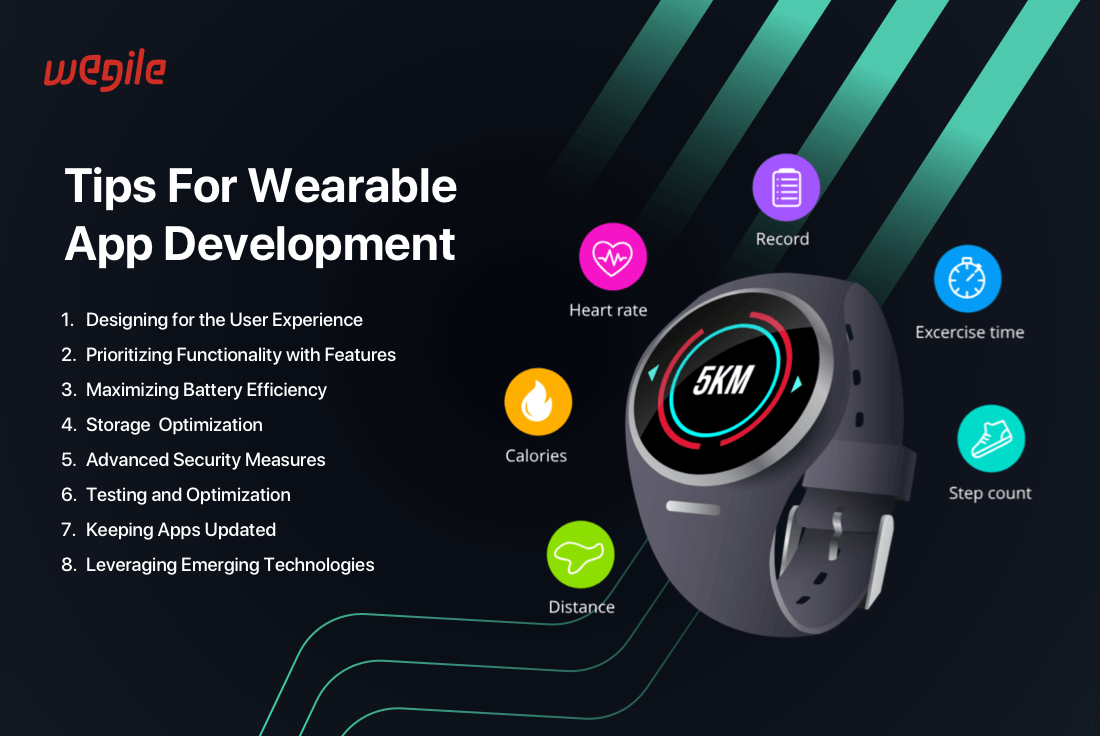
-
1. Designing for the User Experience
When it comes to wearable app development, the focus is on creating a user experience that
goes beyond the usual interface design. It involves crafting a seamless user journey that
makes the most of the limited interaction space available on wearable devices. Our team of
professionals at Wegile is dedicated to streamlining user experience by optimizing
functionality and ensuring easy accessibility. While developing wearable apps, voice and
gesture commands are prioritized over touch inputs, particularly on smaller displays where
touching can be difficult. The aim should be to offer a user experience that is smooth and
intuitive, seamlessly fitting into the user’s everyday routine without any inconvenience or
frustration. This approach guarantees that the wearable device improves the user’s lifestyle
instead of making it more complex. -
2. Prioritizing Functionality with
FeaturesWhile it’s tempting to pack a wearable app with many features, the development strategy
should emphasize the importance of functionality over feature quantity. Every feature should
be meticulously evaluated to ensure its practicality and influence on the device’s
performance and user experience. Important features for wearable apps typically include
activity tracking, personalized notifications, and health monitoring, all designed for
efficient interactions and easy visibility. These features must function consistently and
intuitively, delivering genuine value without burdening the user or draining the device’s
resources. By prioritizing the user’s needs, wearable apps can become indispensable tools
that subtly deliver targeted functionality.
Must Read: The Future Of App Development: Predictions For 2024 And Beyond
-
3. Maximizing Battery Efficiency and
Storage OptimizationBattery efficiency is paramount in wearable technology since smaller batteries are utilized
in such devices. Optimizing battery life extends beyond mere convenience; it is crucial for
user retention and satisfaction. At Wegile wearable app development strategies focus on
minimizing power consumption without compromising app performance. Techniques include
optimizing app processes to run only when necessary, employing low-power sensors, and
reducing background data usage. Effective resource management also plays a key role, where
memory and processor use are finely balanced to ensure smooth operation. By incorporating
these techniques, you can create wearable apps that are both powerful and sustainably
efficient. This will improve the longevity of the device and enhance the user experience. -
4. Advanced Security Measures
Security is a top priority in developing wearable apps, mainly because these devices often
handle sensitive personal data such as health metrics and payment information. It is crucial
to incorporate robust security measures at every level of the development process. This
includes employing secure coding practices to avoid common vulnerabilities, encrypting data
in transit and at rest to protect against data breaches, and implementing robust user
authentication methods. Techniques like biometric verification and multi-factor
authentication can significantly enhance the security posture of wearable devices. By
investing in advanced security measures, businesses can safeguard user data and build trust
in wearable technology. -
5. Testing and Optimization
Thorough testing is indispensable in wearable app development to ensure that applications
perform reliably across all intended devices and scenarios. Given the diversity of wearable
technology, from different screen sizes to varying hardware capabilities, it is crucial to
conduct extensive testing that includes usability, compatibility, and performance
assessments. Optimization efforts should focus on refining the app’s responsiveness and
stability, ensuring it can handle real-world use cases effectively. Emphasizing iterative
testing processes—where feedback is continuously integrated to improve the app—helps
identify and resolve potential issues early, thereby enhancing the app’s overall quality and
user experience. -
6. Keeping Apps Updated
Ensuring that wearable apps remain current is essential for maintaining their functionality
and security. Regular updates allow for the enhancement of features and the resolution of
potential bugs that might impact user experience. Moreover, with each update, it’s essential
to align the app with the latest operating system versions and to take advantage of new
hardware capabilities. Regularly updating the application keeps users engaged and most
importantly, reinforces a strong commitment to maintaining app security. Constantly updating
wearable apps strengthens security protocols and adheres to the most up-to-date data
protection regulations, guaranteeing the app remains secure and compliant. -
7. Leveraging Emerging Technologies
Incorporating emerging technologies can significantly enhance the functionality and appeal of
wearable apps. Techniques like machine learning, augmented reality, and
context-aware computing can transform how users interact with their devices, making applications
more intuitive and responsive to their needs. For instance, machine learning algorithms can
predict user behavior and automate certain functions. At the same time, augmented reality
can provide innovative ways to display information and interact with the physical world
through the device. Embracing these technologies pushes the boundaries of what wearable apps
can achieve and sets a benchmark for future developments in this evolving field.
Wrapping Up
Successful wearable app development necessitates a comprehensive grasp of both the technology and the
users. It encompasses more than just developing an app that works on a wearable device—it needs to
be tailored for the device’s unique design, optimize resource usage, prioritize security, and
consistently integrate user feedback. By adhering to these guidelines, businesses can develop
wearable apps that are both practical and user-friendly, ensuring their long-term relevance and
usability. If you’re looking for a reliable wearable app development company, connect with Wegile. We specialize in providing top-notch wearable app development
solutions. Our team is highly knowledgeable in wearable technology and has a wealth of experience
creating solutions for a wide range of industries. We pride ourselves on catering to clients with
diverse needs and turning innovative visions into reality!
Leave a Reply