Have you ever wondered how a device on your wrist could not only tell the time but also track your
heart rate, monitor your sleep, and even send notifications from your phone? Welcome to the world of
wearable technology, a key player in today’s digital ecosystem that’s redefining how we interact
with the world around us. But why are these devices becoming so integral to our daily lives, and how
are they shaping the future of personal technology?
Wearable devices are more than just gadgets in the digital sphere; they’re personal assistants,
fitness coaches, and healthcare monitors all rolled into one. The global market for wearable
technology is booming, with predictions stating it will soar to a staggering $265.4 billion by 2026.
Why such growth? The answer lies in their widespread applications and the seamless integration they
offer into our personal and professional lives.
This blog goes deep into the realm of wearable app development, exploring the crucial applications,
defining features, and intricate development processes that bring these devices to life. From
smartwatches to fitness trackers and beyond, how are these technologies developed? What makes them
tick? And most importantly, how can they benefit you or your business in this digital age? Let’s
strap in and find out how these small devices are making big waves across industries and lifestyles.
Importance of Wearable App Development in Today’s
Tech-Driven World
In an era dominated by technological innovation, wearable app development stands out as a pivotal
area of growth that promises to significantly shape our daily interactions and lifestyle choices. As
we weave technology more tightly into the fabric of daily life, wearable devices like smartwatches,
fitness trackers, and smart glasses are becoming indispensable tools, enhancing everything from
personal health monitoring to mobile connectivity.
Why
Wearable Technology is More Than Just a Gadget
Trend
Wearable technology has evolved from novelty items to essential tools that offer profound benefits.
These devices, equipped with smart applications, seamlessly integrate technology into our daily
routines, making the digital experience more personal, immediate, and accessible. This shift is not
just about staying up-to-date with the latest gadgets, it’s about enhancing the quality of life,
improving health outcomes, and enabling a more connected world.
-
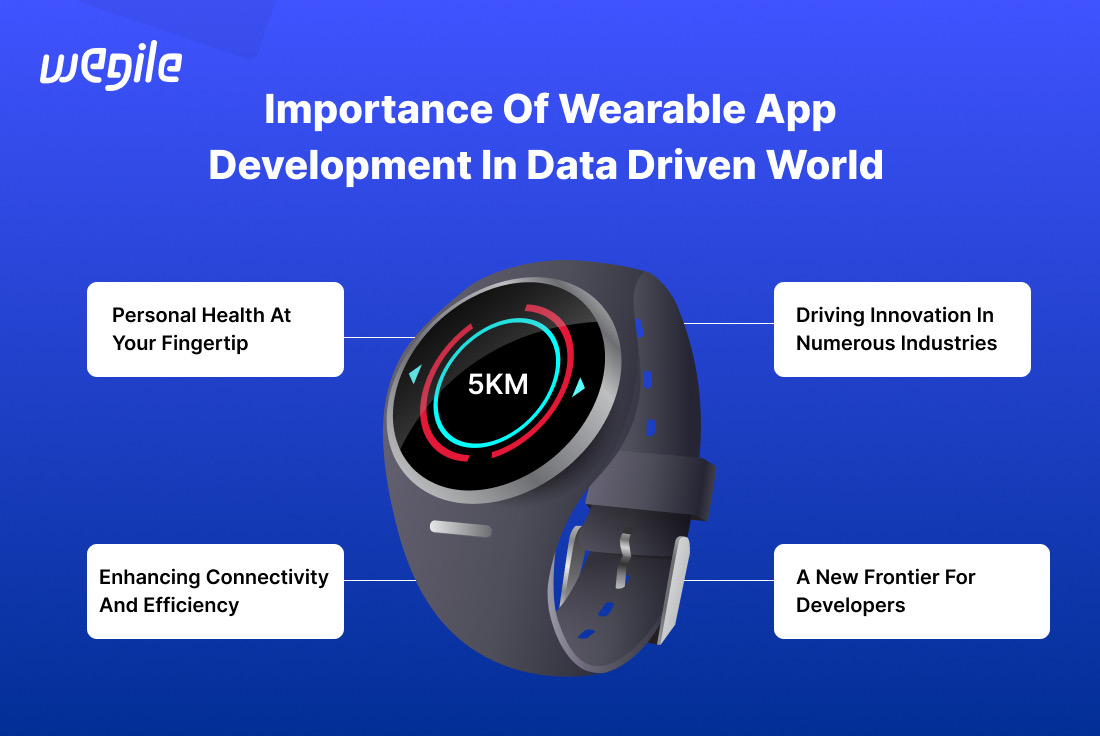
Personal Health at Your Fingertips
One of the most compelling reasons for the rise of wearable technology is its ability to
monitor and manage health and wellness. Apps developed for wearables can track steps,
monitor heart rates, analyze sleep patterns, and even detect abnormalities early. This
constant monitoring offers users a detailed insight into their health, encouraging a
proactive rather than reactive approach to wellness. -
Enhancing
Connectivity and EfficiencyWearable apps also extend the functionality of smartphones. It keeps users connected in more
convenient and efficient ways. Whether it’s checking important notifications on a smartwatch
without pulling out a phone or navigating a city with smart glasses that display directions
right in your line of sight, wearable apps are designed to streamline and simplify user
interactions. This seamless connectivity is particularly crucial as the world becomes
fast-paced and digitized. -
Driving
Innovation in Numerous IndustriesThe impact of wearable app development stretches across various sectors. In healthcare,
wearables are revolutionizing patient care with features that provide real-time health
monitoring and data collection. In fitness, they offer personalized insights that help users
optimize their workouts and health strategies. Even in fields like education and retail,
wearables are finding their place, enhancing learning experiences and personalizing customer
interactions. -
A New
Frontier for DevelopersFor developers, wearable app development represents a new frontier of challenges and
opportunities. Developing for wearables requires a unique set of skills and considerations,
from optimizing user interface designs for smaller screens to ensuring that apps run
efficiently with limited battery life. The intimate nature of wearables demands a higher
standard of privacy and security, pushing developers to innovate not only functionally but
also ethically.
Market Overview: The Expansive Reach of Wearable
Technology
The wearable device market is not just growing; it’s exploding with potential. As of 2024, industry
analysts report a staggering increase in the adoption of wearable technology, with over a billion
devices already in use globally. This surge is projected to escalate, with the market value
anticipated to reach a monumental $265.4 billion by 2026, driven by a compound annual growth rate
(CAGR) of approximately 18%.
What’s Fueling This Growth?
Three main factors are driving the adoption of wearable technology:
-
Health and Wellness Consciousness: As individuals become more proactive
about
their health, the demand for wearables that offer real-time health monitoring such as
activity
trackers and heart rate monitors is skyrocketing. -
Technological Advancements: Innovations in sensors, battery life, and
miniaturization are making wearables more efficient and less obtrusive. Enhanced
connectivity
options such as 5G are also expected to boost the functionality and appeal of wearable
devices. -
Integration into Daily Life: The ability of wearables to integrate
seamlessly
with other smart devices and systems is increasing their utility. This integration makes
them
invaluable for a wide range of applications, from personal fitness and healthcare to
industrial
and enterprise solutions.
Distinction Between Wearable and Mobile App
Development
While both wearable and mobile apps enhance our digital experience, their development landscapes
differ due to the nature of the devices they serve.
-
User Interaction: Wearable apps demand simplicity and immediacy.
Interactions
are typically brief and context-driven, unlike mobile apps, which can engage users in more
complex and prolonged interactions. This difference stems from the fact that wearables are
often
used on the go, requiring glances and simple gestures for operation. -
Display Constraints: Wearable devices come with much smaller screens
compared
to smartphones and tablets. This limitation challenges developers to design apps that can
deliver essential information in a concise and easily digestible manner. The design
philosophy
here is less about the quantity of content displayed and more about its relevance and
timeliness. -
Device Integration: Wearable apps frequently need to interact with other
devices, often serving as a secondary screen or controller for smartphones. It requires
robust
and seamless synchronization between devices, ensuring that the wearable app can fetch and
send
data efficiently without user frustration.
Unique Development Considerations
Developing for wearables also involves special considerations that emphasize the device’s strengths:
-
Context Awareness: Wearable apps excel when they are context-aware. They
can
provide tailored responses based on the user’s current activity or location. This
sensitivity to
context transforms simple notifications into intelligent and actionable insights. -
Battery Efficiency: Given the limited battery capacity of wearables,
optimizing
energy consumption is crucial. Developers must ensure that their apps are not just effective
but
also energy-efficient, striking a balance between functionality and battery life. -
Privacy and Security: Since wearables often collect and transmit personal
data,
ensuring the privacy and security of this data is paramount. Developers must implement
stringent
security measures to protect sensitive information from unauthorized access.
Exploring the World of Wearable Devices and Their
Apps
Wearable technology has diversified into a plethora of devices, each tailored for specific
functionalities and user preferences. From fitness enthusiasts to tech-savvy consumers, there’s a
wearable for everyone. Let’s dive into some of the most popular types of wearable devices and the
distinctive apps that elevate their utility.
Smartwatches: The All-Rounders
Smartwatches are by far the most popular wearable devices today. They serve as an extension of one’s
smartphone, offering a convenient wrist-based display for notifications, calls, and quick responses.
Beyond these basics, smartwatches like the Apple Watch or Samsung Galaxy Watch are powerhouses for
health and fitness monitoring. They track everything from your daily step count and heart rate to
more complex health metrics like blood oxygen levels and electrocardiogram (ECG) readings. Popular
apps for smartwatches include:
-
Fitness Tracking: Apps like Fitbit and Apple’s Fitness+ not only track
workouts
but also provide on-screen workouts and health coaching. -
Navigation: Google Maps on a smartwatch can guide you with turn-by-turn
directions right on your wrist, making it incredibly convenient for travelers and cyclists. -
Payment Apps: With NFC technology, apps like Apple Pay and Google Wallet
allow
for tap-to-pay directly from your watch.
Fitness Bands: The Fitness Companions
Fitness bands are streamlined for continuous health and activity monitoring. Devices such as the
Fitbit Charge or Xiaomi Mi Band focus heavily on fitness tracking but with less emphasis on
communication features. Their dedicated apps provide detailed analytics on your physical activities,
sleep patterns, and stress levels, helping users make informed lifestyle choices. Key features
include:
-
Sleep Monitoring: Most fitness bands come with apps that analyze sleep
quality,
providing insights into sleep cycles and suggestions for improvement. -
Activity Reminders: To keep users active, these apps often send nudges or
alerts to move if you’ve been inactive for too long. -
Smart Eyewear: Smart eyewear like Google Glass or Snapchat Spectacles adds
a
layer of augmented reality (AR) or simply a hands-free digital experience to everyday
eyewear.
These devices are capable of displaying notifications, capturing photos, or even streaming
video
directly through the lenses. They are particularly useful in:
-
1. Professional Fields: Apps developed for smart eyewear can assist in
fields
like
surgery, engineering, and logistics by providing real-time data and augmented overlays that
enhance precision and understanding. -
2. Social Interaction: Apps that allow for live streaming or direct social
media
interaction through voice commands are popular among smart eyewear users.
Specialized Wearables: Focused Functionality
Beyond the mainstream, the wearable market includes devices designed for specific needs:
-
Child and Elderly Trackers: Devices like AngelSense provide GPS tracking
and
emergency alerts for caregivers. It ensures peace of mind for family members of young
children
or elderly relatives. -
Pet Wearables: Products like Whistle offer GPS tracking and fitness
monitoring
for pets. It helps owners keep track of their furry friends’ location and activity levels.
Revolutionizing Industries with Wearable Apps: From
Healthcare to Fintech
Wearable technology is not just a consumer gadget phenomenon; it’s a multifaceted tool transforming
a
wide array of industries by enhancing efficiency, personalizing user experiences, and simplifying
complex tasks. Here’s how different sectors are harnessing the power of wearable apps to innovate
and improve their operations.
Healthcare: A Lifeline on Your Wrist
In the healthcare sector, wearable technology is becoming a cornerstone of patient management and
preventive care. Wearable devices equipped with specialized apps are used for continuous health
monitoring, offering real-time data that can be crucial for chronic disease management and
emergencies. For example:
-
Remote Patient Monitoring: Devices like the Philips Health Watch provide
doctors with patient data in real time, enabling conditions like heart disease and diabetes
to
be managed remotely. This not only improves patient outcomes but also reduces the need for
frequent hospital visits. -
Mental Health Monitoring: Apps like Moodpath, which can be used with
various
wearable devices, track psychological states over time to detect patterns and potential
mental
health issues, offering therapeutic exercises and direct pathways to professional help.
Fitness: Customized Coaching on the Go
The fitness industry thrives on personalization, and wearable apps are at the forefront of
delivering
customized fitness coaching directly to users’ wrists. These apps provide feedback on performance,
set goals based on user activity, and even adjust recommendations in real time based on the wearer’s
progress and health stats. For instance:
-
Interactive Fitness Programs: The Nike Training Club app on smartwatches
tailors workout sessions based on the user’s fitness level and goals, integrating with the
watch’s sensors to track performance and provide on-the-spot advice. -
Community Engagement Features: Apps like Strava not only track steps and
cycling routes but also connect users with a community of athletes for motivation and social
interaction.
Education: Enhancing Learning with AR
Educational tools are becoming more interactive and engaging through the use of wearable technology.
Smart glasses and AR wearables are pioneering new ways to learn and explore subjects by overlaying
digital information onto the real world, making learning immersive and more impactful:
-
Augmented Reality Learning: Devices like Microsoft HoloLens are used in
medical
and science education to project 3D models of human anatomy or complex molecular structures,
allowing students to explore and interact with them in a way that textbooks never could. -
Field Trips and Experiments: AR wearables can enhance field trips by
providing
contextual information directly to students’ field of vision, enriching their learning
experience with real-time data and insights.
Fintech: Secure and Seamless Transactions
In the fintech sector, wearable apps are simplifying the way we handle transactions and manage
finances. With an emphasis on security and ease of use, these apps are making mobile banking and
payments more accessible and user-friendly:
-
Contactless Payments: Smartwatches with apps like Apple Pay or Samsung Pay
allow users to make secure, contactless payments quickly, without the need to pull out a
card or
cash. -
Financial Monitoring: Apps like Mint or YNAB on wearables help users keep
track
of their spending and budget in real-time, directly from their wrist, making financial
management seamless and more integrated into daily life.
The Wearable App Development Process: From Ideation
to Deployment
The journey of creating a wearable app is intricate and fascinating, involving several stages that
transform a simple concept into a fully functional application that resides on users’ wrists or in
their visual field. Here’s a comprehensive guide to the wearable app development process,
emphasizing the critical role of user-centric design throughout each phase.
-
Step 1: Ideation and Conceptualization
The first step in the development process is ideation, where the magic begins. Here,
developers and stakeholders brainstorm to identify the core functionalities, target users,
and objectives of the wearable app. This stage is crucial for aligning the app’s
capabilities with market needs and potential technological constraints.-
User Research: Understanding the needs and behaviors of the target
audience through surveys, interviews, and market analysis. -
Concept Development: Defining the app’s purpose and sketching
preliminary designs, considering the unique attributes of wearable devices like
smaller
screen sizes and varied contexts of use.
-
-
Step 2: Feasibility Analysis
Once the concept is clear, a feasibility study assesses whether the app’s technical and
financial aspects are viable. It involves:-
Technical Assessment: Checking the compatibility of the app with
existing wearable technologies and ensuring it can operate within its limitations,
such
as processing power and battery life. -
Budgeting: Estimating costs related to development, testing, and
post-launch maintenance to ensure the project stays economically feasible.
-
-
Step 3: Design and Prototyping
With feasibility affirmed, the design phase starts. This stage is critical in wearable app
development due to the need for simple, intuitive user interfaces that can be navigated
quickly.-
User Interface (UI) Design: Creating visual elements that are not
only
aesthetically pleasing but also functional on small screens. Importance is given to
minimalist designs that provide information at a glance. -
User Experience (UX) Design: Ensuring the app delivers a seamless
and
engaging user experience, including easy navigation and quick access to important
features. -
Prototyping: Developing a prototype to give stakeholders a tangible
look and feel of the app, which is vital for gathering feedback and making iterative
improvements.
-
-
Step 4: Development
This phase involves the actual coding and programming of the app. Developers must:
-
Select Development Tools: Choose the right platforms and tools that
support the integration of necessary features while optimizing performance. -
Coding: Write code that is clean, efficient, and scalable. Given
the
hardware constraints of wearable devices, optimizing code for performance and
battery
efficiency is paramount.
-
-
Step 5: Testing and Quality Assurance
Testing is an iterative process that typically runs alongside development. This stage is
crucial to ensure the app is free from bugs and meets all user requirements.-
Functionality Testing: Ensures every function of the app works as
intended. -
Usability Testing: Tests the app’s user interface and user
experience
elements to ensure they are intuitive and user-friendly. -
Performance Testing: Checks the app’s stability and responsiveness
under different conditions.
-
-
Step 6: Deployment and Launch
After testing, the app is ready for deployment. This stage involves:
-
Launch Preparation: Finalizing marketing materials and app store
listings. -
Distribution: Publishing the app on relevant platforms, such as the
Apple App Store or Google Play for Wear OS devices. -
Monitoring: Keeping an eye on the app’s performance and gathering
user
feedback for any immediate amendments or updates.
-
-
Step 7: Post-Launch Support and Updates
The development cycle doesn’t end at launch. Ongoing support is essential to retain users
and
maintain app relevance.-
User Feedback: Continuously collecting and analyzing user feedback
to understand their needs and pain points. -
Updates: Regularly updating the app with new features, bug fixes,
and improvements based on user feedback and emerging trends.
-
Technical Considerations in Developing Wearable Apps
Developing wearable apps comes with its own set of technical challenges that developers need to
navigate carefully.
-
Device Integration
Wearable devices often need to integrate seamlessly with other devices, like smartphones or
even other wearables. This requires robust Bluetooth connectivity and synchronization
capabilities so that data can flow seamlessly between devices, ensuring that the user
experience is smooth and consistent. -
Data Security
Given that wearable devices often collect highly personal data (like health metrics),
ensuring the security of this data is paramount. Developers must implement strong encryption
for data storage and transmission, alongside secure authentication mechanisms to protect
sensitive information. -
Battery Optimization
Battery life is a significant concern in wearable devices due to their size and the
continuous data processing they perform. Developers need to optimize app performance to
consume as little power as possible, employing strategies like minimizing background
activity and reducing the frequency of updates and data synchronizations.
Cost
Factors in Developing Wearable Apps
-
Device Type
The type of device for which the app is being developed can influence the cost. For example,
developing apps for advanced smartwatches with extensive features and sensors can be more
expensive than simpler fitness bands. -
Complexity
The complexity of the app also affects development costs. More features, customizations, and
the need for integrating with multiple systems increase the workload and the required hours
of development, driving up costs. -
Development Platform
Choosing the right development platform can also impact costs. Some platforms may offer more
streamlined development tools and libraries that can reduce the time and effort needed to
build the app, while others might require more custom coding and testing.
Case Studies: Triumphs in Wearable
App Development
The pathway to mastering wearable app development is paved with learning from successful ventures.
By analyzing specific case studies, we uncover valuable lessons and best practices.
Case Study: Fitbit’s Evolution
Fitbit, a leader in the fitness-tracking wearable sector, has continuously evolved its offerings to
enhance user engagement and health monitoring. Their integration of sleep tracking that provides
users with detailed insights into sleep patterns and offering personalized tips for improvement
stands out.
Lesson Learned: Continuous improvement based on user feedback and advancing
technology enhances product value and user loyalty.
Case Study: Apple Watch and Emergency SOS
Apple introduced the Emergency SOS feature in its smartwatch, which significantly impacted user
safety by allowing users to contact emergency services with a simple gesture. This feature not only
saved lives but also increased consumer trust and reliance on wearable technology.
Best Practice: Incorporating life-enhancing features can significantly raise a
product’s profile and its perceived value to users.
The
Future of Wearable App Development
As we look to the horizon, the future of wearable technology appears vibrant and filled with
potential. Here’s what we can anticipate:
Enhanced AI Integration
The integration of Artificial Intelligence (AI) in wearable apps is set to deepen. Predictive
analytics will play a larger role in how devices understand and anticipate user needs and behaviors,
making wearables more intuitive and personalized.
Expansion into New Markets
Wearable technology is set to expand beyond fitness and health into sectors such as finance,
education, and even industrial applications, where they can enhance safety and operational
efficiency.
Increased Interconnectivity
The concept of Internet of Things (IoT) where everyday objects are connected to the Internet and
integrated with wearable devices will enhance how users interact with their environment, making
these interactions more seamless and automated.
Final Words
From enhancing personal health to transforming industry operations, wearable technology has carved a
niche that continues to grow in depth and breadth. The lessons learned from successful projects
highlight the importance of user-centric design, continuous innovation, and the integration of
life-enhancing features.
Investing in wearable technology is not merely about keeping up with trends, it’s about actively
shaping the future of how businesses engage with their customers and how individuals manage their
health and productivity. As we continue to integrate technology into every aspect of our lives, the
potential for wearable technology to enhance daily living and operational efficiency is boundless.
Are you ready to explore the dynamic world of wearable technology? Contact Wegile, the best wearable app development
company, to discover how we can transform your ideas into successful, innovative wearable
apps that stand out in the market. Let’s build the future together, reach out today to start your
journey in the wearable technology.
Leave a Reply