Wearable technology has transitioned from a concept often
depicted in science fiction to a practical tool embedded in our everyday lives and workspaces. Its
integration with enterprise app development presents vast opportunities to enhance productivity.
Businesses across various sectors are embracing wearable devices to maintain a competitive edge.
They
find these devices crucial not just for individual tasks but also for revolutionizing business
operations. This blog explores the impact of wearable devices on enterprise app development. It
illustrates how different industries leverage this technology to promote growth and efficiency.
Are you curious about how wearable tech could revolutionize your business operations?
Continue reading to explore the myriad possibilities!
What is Wearable
Technology?
Wearable technology is commonly referred to as “wearables.” It is a technology designed to be worn
on
the body as accessories or incorporated into clothing. These devices, which include smartwatches,
fitness trackers, and augmented reality (AR) glasses, are equipped with sensors and advanced
features. They keep users connected, monitor health, and facilitate seamless digital interaction
without handheld devices.
For example, smartwatches offer functionalities beyond displaying time. They can also manage emails,
track heart rates during physical activities, and even allow users to control home lighting systems
with a simple wrist tap. Fitness trackers act as digital fitness assistants by counting steps,
monitoring sleep patterns, and prompting physical movement. AR glasses, such as Google Glass or
Microsoft HoloLens, enhance real-world experiences by overlaying digital information. They provide
everything from navigational assistance to real-time translations of foreign signs.
Technologically, wearables have advanced with improvements in connectivity through faster Bluetooth
and Wi-Fi. These technologies facilitate efficient real-time data transmission. In the business
world, the use of wearables is growing. It is significantly improving workplace productivity,
safety, and communication. For example, in manufacturing, these devices monitor worker’s physical
conditions and issue alerts for health or safety risks, thereby reducing workplace accidents.
This fusion of fashion, utility, and technology is altering how we interact with technology and
revolutionizing our personal and professional lives, one smart device at a time.
Benefits of Wearable Technology in Enterprise App
Development
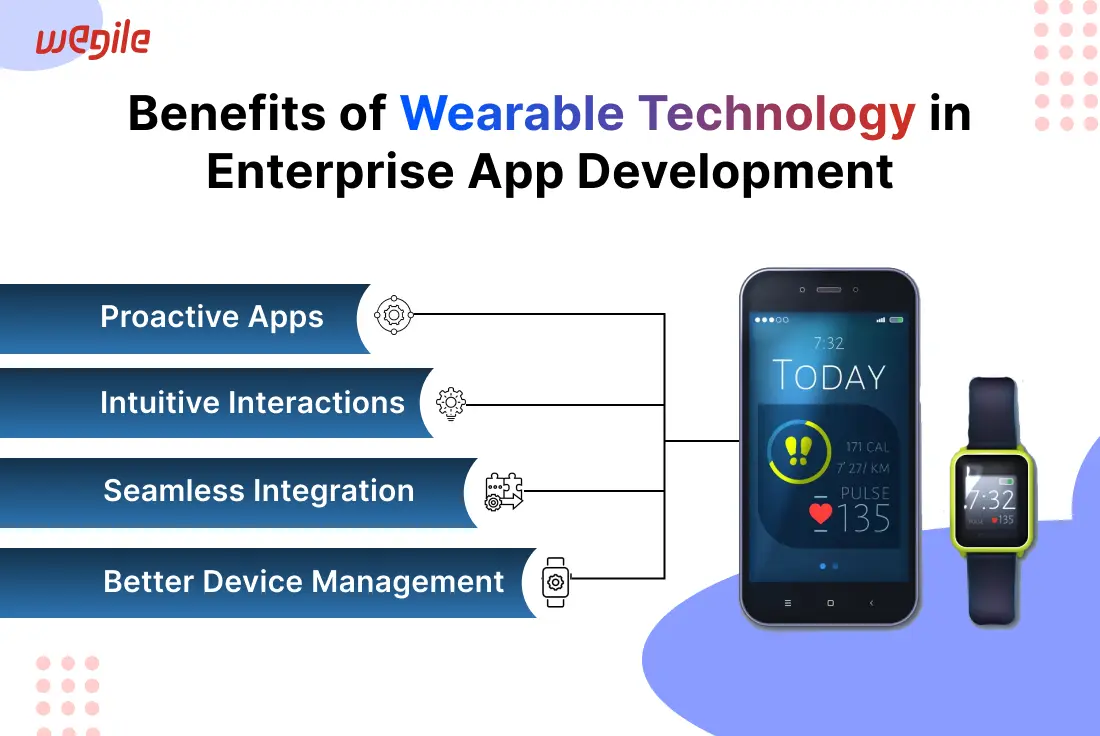
Intuitive
Interactions
Wearable
tech
is revolutionizing enterprise app development by
prioritizing simplicity and efficiency in design. With intuitive interactions like simple gestures,
voice commands, or quick taps, users can complete tasks swiftly. They no longer have to deal with
cumbersome interfaces or complex procedures. This approach ensures that technology keeps pace with
users, which enhances productivity and mobility.
Proactive Apps
Wearable devices excel in proactive functionality. Beyond merely responding to user commands, they
anticipate needs through intelligent alerts such as suggesting breaks or adjusting routines. This
predictive capability can streamline daily activities and increase safety by addressing potential
issues before they arise.
Seamless Integration
As wearable technology evolves, its integration with broader business systems becomes more refined.
Developers are focused on ensuring these devices synchronize flawlessly with essential business
tools like ERP and CRM systems. The seamless connection allows the granular data collected by
wearables to contribute to a larger strategic understanding. It is facilitating smarter and more
strategic business decisions.
Better Device
Management
Integrating wearables into the workplace is becoming standard, elevating the importance of effective
device management. It’s critical not only to maintain device security but also to ensure they
integrate smoothly with existing technological ecosystems. Effective management ensures all devices,
from tablets to smartwatches, operate optimally without issues. It supports a cohesive and efficient
work environment.
How Wearable Tech is Revolutionizing Enterprise App
Development
Wearable technology is more than simple accessories like wrist gadgets or advanced eyewear. It
serves
as a pivotal element in reshaping business application development across industries. Let’s explore
how these compact yet powerful devices significantly impact various sectors by innovating enterprise
app development.
Healthcare
-
Remote Monitoring Comes Alive: Imagine a scenario where physicians monitor
your health continuously without needing a clinic visit. Wearable-driven apps facilitate
this by synchronizing seamlessly with devices. They track vital health metrics around the
clock, providing timely medical interventions when necessary. -
On-the-Pulse Health Data Apps: These applications are frontline solutions
that process real-time health statistics. They enable healthcare providers to identify
potential issues early. This shifts from a reactive to a proactive care model, thus
enhancing patient outcomes.
Manufacturing
-
Hands-Free Info at Your Fingertips: In factory environments, hands-free
applications on devices like AR glasses display crucial information directly in the user’s
line of sight. This integration reduces interaction with physical devices, allowing workers
to concentrate more effectively. -
Stay Safe with Smart Alerts: Safety is paramount in manufacturing. Wearable
apps continuously monitor the environment. They provide immediate alerts for hazards like
toxic gases or extreme temperatures, enhancing workplace safety.
Retail
-
Boosting Customer Service with a Tap: In the competitive retail sector,
efficiency and service quality are key. Wearable apps enable staff to receive alerts
directly on their devices. It ensures they can respond to customer needs promptly leading to
enhanced customer satisfaction. -
Intelligent Scanning for Smoother Stocks: Wearable scanners streamline
inventory management. Apps designed for these devices assist staff in scanning barcodes and
managing stock levels efficiently. This maintains seamless store operations.
Logistics
-
Navigating Success with Fleet Apps: Timely delivery is essential in
logistics. Wearable apps, which provide drivers with real-time updates and optimal routing
directly on their wrists, ensure efficient package delivery and route management. -
Scan and Go with Wearable Barcode Apps: In logistics, processing speed is
crucial. Wearable scanner apps expedite package handling by reducing manual input errors and
saving time. This optimizes the logistics workflow.
Challenges in Wearable App Development
Developing apps for wearable devices is an exciting venture. But, it involves navigating several
complex challenges to ensure these small technological marvels operate flawlessly. Here are some of
the critical obstacles developers face:
-
1. Device Compatibility: Creating wearable apps is similar to facilitating
a
multilingual conversation. Each device, whether a smartwatch, fitness tracker, or AR
glasses, operates on its unique platform with its own rules and languages. Developers must
translate and harmonize these differences effectively to ensure seamless communication
between devices. This capability is vital for app functionality across different ecosystems. -
2. Data Security: Wearable devices collect vast personal data, from
activity
levels to heart rates. With sensitive information involved, developers must ensure data
security by creating solid protections that are easy for the rightful owner to access but
hard for anyone else to breach. Ensuring robust security measures is critical to protect
user data from potential cyber threats. -
3. Battery Life Management: Unlike other gadgets, wearable devices are
expected
to be constantly on and ready for action. This can significantly drain their power.
Developers are tasked with optimizing battery life so these devices can operate efficiently
throughout the day or longer without frequent recharges. -
4. Durability in Design: Wearables accompany users in various environments,
including harsh weather. Developers must design apps that function well and contribute to
the device’s overall durability and resilience. This involves ensuring that the wearable can
withstand tough situations without suffering damage.
Future
Trends in Wearable Technology for Enterprises
-
Predictive Analytics and Machine Learning Take the Lead: Imagine wearables
that show current conditions and predict future events. This is where machine learning and
predictive analytics become essential. Future wearables will analyze data instantly, learn
from it, and make precise predictions. For example, a wearable in a factory could predict
when a machine will break down, saving time and money and preventing accidents. Similarly, a
wearable used by sales teams might forecast upcoming sales trends, helping businesses stay
ahead. It’s like having a futuristic crystal ball on your wrist! -
Expansion of IoT (Internet of Things) Ecosystems: The Internet of Things
(IoT) mainly aims to connect devices to make life easier and more efficient. We’ll see a
significant increase in these connections in the future, with wearable devices playing a key
role in larger IoT systems within businesses. Imagine every piece of equipment, tool, and
garment linked together through wearables, allowing for smooth data flow and automation
across different sectors. For example, in healthcare, everything from hospital beds to
ambulances could be monitored and controlled through a smartwatch. -
Next-gen Wearables – E-textiles and Advanced Biometrics: The next
generation
will surpass the usual wristbands and headgear. We can expect E-textiles or clothes with
built-in computing power. For example, a doctor’s lab coat could monitor cleanliness, or a
firefighter’s uniform could track heat exposure and vital signs. Also, more advanced
biometric wearables are on the way. These will do more than count steps or check heart
rates; they’ll also monitor stress, hydration, and critical health indicators like heart
rhythm, cholesterol, and blood sugar levels in real-time.
Final Words
Wearable technology is transforming the business world and the future of wearable
tech
is indeed very bright. It is
streamlining everything from routine tasks to complex operations. Imagine a workplace where
smartwatches manage schedules and fitness trackers monitor health, all integrated smoothly into
daily work routines. This shift is more than just keeping up with tech trends; it’s about
revolutionizing business operations to make them more connected and efficient.
As wearable tech becomes more integral to business, the opportunities for innovation expand. If you
want to introduce this cutting-edge technology to your company, Wegile can assist you. We specialize
in developing customized wearable apps tailored to your specific business needs. We will help you
lead the way in your industry. Let’s make it happen with Wegile’s wearable app
development,
where your business meets the future
of technology!
Leave a Reply