
AngularJS is a robust front-end framework managed by Google. It has been a favorite among developers
for building dynamic single-page applications. As startups focus on growth and scalability, it’s
crucial to choose a technology stack that can adapt and scale efficiently. In this blog, we will
explore AngularJS’s scalability for growing startups. We will also examine its features,
architecture, real-world applicability, and much more, so let’s get started!
What is AngularJS?
AngularJS stands out in the crowd of web development frameworks due to its comprehensive approach to
building web applications. It provides a structured framework that supports web applications with
client-side interactivity. Plus, it enhances HTML’s capability by incorporating dynamic views into
web applications. This transformation of HTML into a dynamic environment assists developers in
creating more expressive and readable environments.
AngularJS operates on the principle of enriching HTML with additional attributes called directives.
These directives introduce new syntax non-existent in traditional HTML, including features like
loops, conditionals, and handlers. By integrating these into HTML attributes, AngularJS facilitates
a more declarative way of defining the app’s business logic directly within the HTML.
AngularJS’s design philosophy encourages developers to separate their application’s logic from
DOM manipulation and instead place it in controllers and services. This separation of concerns
simplifies the process of building and managing complex applications by enabling a higher degree of
modularity.
Benefits of
AngularJS for Modern Web Development
AngularJS offers many advantages that make it a preferred framework for developers looking to build
cutting-edge web applications. Here are some key benefits that AngularJS brings to the table:
-
Enhanced Testing Capability
AngularJS is designed with testing in mind. It supports both unit and end-to-end testing,
which is integral for guaranteeing the quality and functionality of applications. This
built-in testing capability makes it easier for developers to identify and rectify issues
early in the development process. -
Increased Development Efficiency
AngularJS offers features like templates, directives, and filters that can significantly
accelerate the development process. Templates allow developers to quickly build views using
simple HTML. Directives offer extended HTML functionality with custom elements and
attributes. Filters allow developers to manipulate data on the front end effortlessly,
reducing the need to rely on server-side processing. -
Large Community Support
Being an open-source framework developed by Google, AngularJS has a robust community of
developers and experts who continuously contribute to its development. This community
provides a rich ecosystem of resources, plugins, and tools that facilitate the development
of AngularJS applications. For developers, this means access to many solutions to common
problems and ongoing support for new features and issues. -
Improved Readability and Maintainability
Thanks to AngularJS’s modular design, applications are more structured and easier to manage.
This structure allows teams to work more effectively in a collaborative setting, as
different application parts can be managed and developed independently. The clarity of the
code structure improves readability, which is beneficial for the long-term maintenance of
the application.
Key Features of
AngularJS
-
Two-Way Data Binding

AngularJS’s two-way data binding mechanism ensures a real-time synchronization
between the model and the view components of the application. This automatic synchronization
facilitates a dynamic and interactive experience as any changes in the model immediately
update the view, and any changes in the view are immediately reflected in the model. This
keeps the developer from writing additional code to handle these updates. It is particularly
advantageous in environments where quick product iterations are common. Startups can benefit
from this because it streamlines the development process. It reduces the time and effort
involved in manually managing these updates. -
MVC Architecture
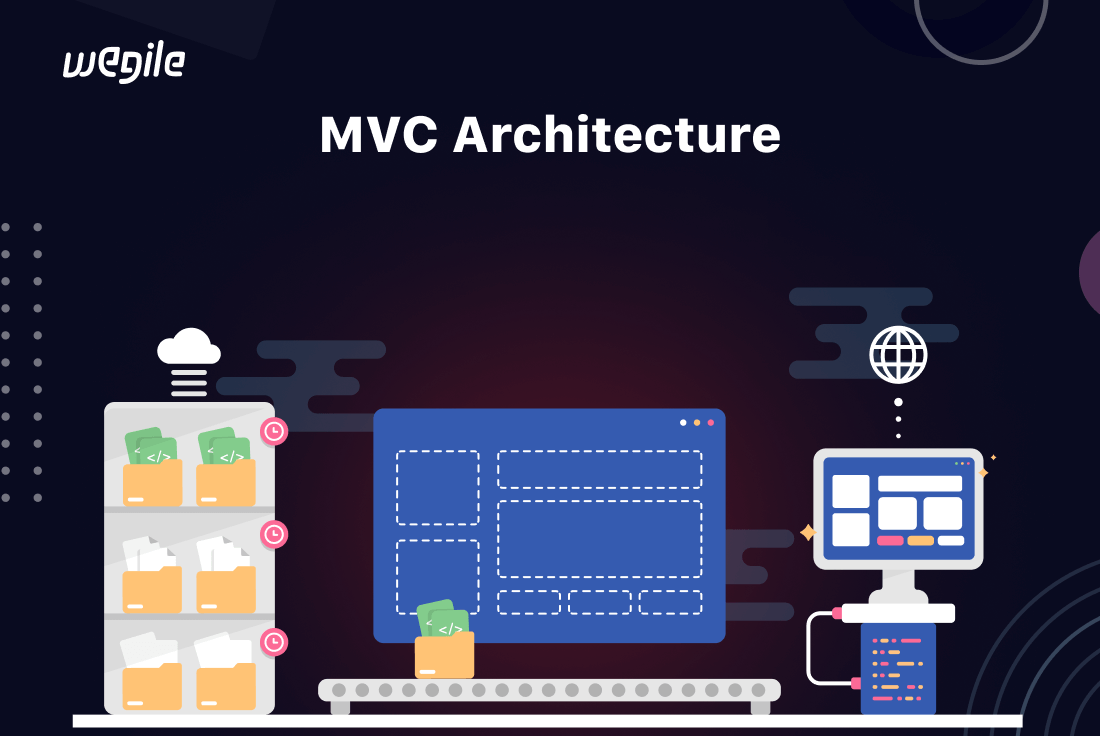
AngularJS provides a straightforward implementation of the
MVC (Model-View-Controller) architecture. It helps in managing the complexity of web
development projects. By automatically handling the synchronization between the MVC
components, AngularJS allows developers to focus more on the actual application development
rather than the technical details of the platform. AngularJS’s implementation of MVC architecture
splits the application into three interconnected components. The Model represents the data,
and the View displays that data (and sends user actions to the Controller), and the
Controller changes the data/state of the Model and updates the View in response. This clear
separation facilitates a structured approach to application development that is easier to
manage and scale. For startups, this means that as the application grows and more developers
get involved, it remains easier to manage because each component can be worked on
independently. -
Dependency Injection
AngularJS’s dependency injection subsystem is a design pattern that manages how
components and services get created and how they interact. Each component in AngularJS can
have dependencies defined as external elements, which can be services, values, or other
frameworks. AngularJS’s injector subsystems provide these dependencies to components as
needed. It ensures that components are not hard-coded but are dynamically loaded and
managed. This approach greatly simplifies the development of large-scale applications by
making the code more modular, testable, and maintainable. For startups, the application is
easier to update and scale as new features can be added, or existing features can be
modified without having to rewrite other application parts.
Scalability
Features of AngularJS
-
Modular Development

The modular development approach in AngularJS is particularly beneficial for
startups because it supports a clean and organized codebase. Each module in AngularJS can be
encapsulated with its specific functionality, making it highly maintainable and testable.
This modular system also supports lazy loading, which means that certain parts of the
application can be loaded on demand. This capability can significantly enhance the
application’s performance by loading only the necessary modules. It is particularly useful
as user bases grow and application functionalities expand. -
Extensive Community Support
AngularJS’s robust community is not only large but also highly active. It offers
a plethora of plugins and extensions that can extend the framework’s functionality. This
extensive community support translates into various ready-to-use solutions, which can
drastically reduce development time for new features and functions in a startup’s product.
Community forums, professional networks, and extensive documentation make it easier for new
developers to get up to speed and contribute to projects quickly. This level of support is
invaluable for startups that need to innovate and adapt rapidly to market demands. -
Real-Time Testing

AngularJS enhances its support for scalability through its built-in testing
abilities that allow for end-to-end and unit tests. This intrinsic testing capability is
crucial for maintaining high-quality code standards. This, in turn, reduces the cost and
effort associated with troubleshooting and debugging. It helps startups maintain a stable
product even as new features are rolled out.
AngularJS in the
Real World
Case Study: Upwork and AngularJS
Upwork is a leading global freelancing platform that leverages AngularJS to manage its complex
front-end requirements. The platform handles daily user interactions, from job postings and
applications to user communication and payment processing. AngularJS’s ability to facilitate dynamic
content updates and real-time interactivity is crucial in Upwork’s environment, where freelancers
and clients worldwide interact continuously. The modular nature of AngularJS allows Upwork to scale
its operations efficiently. It enables the development team to update and deploy new features
quickly without disrupting the overall service. This capacity to manage real-time data binding and
maintain a responsive user interface makes AngularJS a fitting choice for a platform as dynamic and
user-focused as Upwork.
Case Study: PayPal and AngularJS
PayPal is one of the world’s largest online payment systems. It utilizes AngularJS for its complex
front-end architecture to ensure smooth, secure, and fast processing of financial transactions
globally. AngularJS supports PayPal’s need for robust security features and the ability to handle
simultaneous transactions at a massive scale. The framework’s built-in security features, such as
HTML escaping and easy integration with secure backend APIs, help protect against common web
vulnerabilities.
Performance and Limitations of AngularJS
AngularJS is designed to offer a powerful platform for building interactive and dynamic web
applications. However, like any technology, it has certain limitations that can impact performance,
especially in large-scale applications. Here are some of the performance issues and corresponding
mitigation strategies:
-
Deep Watch Lists: AngularJS uses “watchers” to
track changes in the model and update the view accordingly. In large applications, having
too many watchers can slow down the digest cycle, as AngularJS checks each watcher every
time there is a model change.Optimization Strategy: To mitigate
this, developers should:-
Limit the number of watchers by reducing unnecessary bindings.
-
Use one-time bindings where possible so that AngularJS stops watching once the value
stabilizes. -
Avoid deep nesting of scopes, as it can lead to performance degradation due to
complex prototype inheritance.
-
-
Complex Scope Hierarchy: AngularJS’s scope
hierarchy can become complex in large applications, which slows down the digest cycle
because AngularJS must traverse this hierarchy to check for changes.Optimization Strategy:
-
Flatten the scope structure as much as possible.
-
Encourage component-based architecture to isolate scopes and reduce the impact on
the
overall application.
-
-
DOM Manipulation: AngularJS’s data binding can
lead to excessive manipulation of the DOM if not managed carefully, which is costly in terms
of performance.Optimization Strategy:
-
Use directives sparingly and keep DOM manipulation within directives to a minimum.
-
If possible, employ virtual DOM techniques or integrate with other libraries that
provide virtual DOM capabilities to minimize direct DOM manipulation.
-
-
Digest Cycle Management: The AngularJS digest
cycle is a loop process that checks for changes in the watch list and updates the DOM
accordingly. Inefficient management of this cycle can lead to performance issues.Optimization Strategy:
-
Manage the digest cycle manually in complex applications by strategically applying
$apply() or $digest() to limit the scope of change detection. -
Optimize change detection by debouncing or throttling model updates, especially in
response to high-frequency events like window resizing or typing.
-
Best
Practices for Scalability in AngularJS
-
Keeping App Components Stateless
Stateless components in AngularJS are designed to improve performance and scalability by not
retaining any internal state beyond their inputs. This design philosophy allows these
components to function purely based on the data they receive. It makes them predictable and
easier to debug. A stateless architecture promotes better data management strategies, such
as using services to manage the state. It centralizes state management and makes it more
transparent across the application. This approach aligns with functional programming
principles, which can help reduce side effects and improve the maintainability of the code. -
Lazy Loading
Lazy
loading not only improves the startup speed but also reduces the initial payload ofweb applications. In AngularJS, this is particularly beneficial for applications with many
features or modules. It makes sure that users only download the resources they need when
they need them. This selective loading can greatly enhance the user experience by making the
application feel much quicker and more responsive. Plus, lazy loading can be strategically
used to split the application into feature-based modules, which can be loaded on demand.
This modular approach is key to building large-scale applications that are both efficient
and manageable. -
Minimize Watchers
Reducing the number of watchers in an AngularJS application helps optimize the digest cycle,
which is the mechanism AngularJS uses to detect changes in the application state and update
the DOM accordingly. Each watcher represents a binding between the UI and the data model,
and having fewer bindings means that the digest cycle completes faster. This reduction can
lead to performance gains, especially in complex applications with many UI elements.
Developers can reduce the number of watchers by avoiding unnecessary bindings. They should
use one-time bindings for static data. Simplifying expressions in bindings can also lower
computational load during the digest cycle.
Final Words
AngularJS offers a solid foundation for startups looking to build scalable applications. Its
comprehensive features, like two-way data binding, MVC architecture, and dependency injection, make
it a robust choice. However, like any technology, understanding its best practices and potential
limitations is key to effectively leveraging its strengths. For growing startups, AngularJS provides
both the flexibility and the infrastructure needed to scale smoothly and efficiently.
Incorporating AngularJS into your startup’s technology stack can be a strategic move that supports
rapid growth and scalability, providing a competitive edge in the competitive tech landscape. Ready
to fetch the power of AngularJS for your startup? We are a reliable
AngularJS development
company specializing in crafting custom AngularJS solutions that drive growth and enhance
scalability. Reach out today, and let’s transform your vision into reality with the robust
capabilities of AngularJS.
Leave a Reply