
At the center of mobile app development, there is one often-overlooked factor that quietly shapes our
digital experiences – Information Architecture (IA).
It’s like a compass that guides users through an intricate maze of buttons, screens, and menus,
providing them with an enjoyable journey.
But what’s the buzz all about? Well, that is exactly why we are here to help you discover!
Imagine your mobile app as an incredible skyscraper that stands as an emblem of creativity and
innovation.
Now, what’s the one thing you absolutely need to ensure this architectural marvel’s stability and
success?
A solid foundation, right? Information Architecture UX is that foundation. It’s the blueprint that
architects the layout, the pathways, and the structure of your app.
But in an ever-evolving app development landscape, we require more than a strong base. We require a
strong framework that can expand, adapt, and scale with our business: a Scalable Information
Architecture!
In this article, we’ve unveiled the strategy of crafting a Scalable Information Architecture UX in
2023 for your app’s success.
What Is
Information Architecture (IA)?
So, what’s at the core of Information Architecture?
Imagine it as the framework that organizes and categorizes all the content within your app.
Just as a library organizes books by sections. Architecture Information specializes in organizing
your application’s content into separate compartments.
Information Architecture UX ensures that each piece of data has an easily accessible location, making
it simpler for users to locate what they require within the app.
Imagine walking into a library where books were scattered randomly on shelves without labels.
Would it ever be easy for you to locate that perfect book you’re looking for?
Information architecture is the librarian who organizes them neatly onto shelves with clear labels.
Hence, this way, you can locate exactly that one book that interests you.
But wait, there’s more to it!
IA goes beyond simply organizing things neatly; it also involves designing an intuitive navigation
system with menus and buttons to ensure your users can seamlessly use your app.
Information architecture’s job also lies in designing these pathways so users can navigate easily
throughout your app.
Imagine having road signs guiding your way effortlessly around an unfamiliar city and helping ensure
that you won’t end up lost!
That is what a well-designed IA does for your app: it ensures your journey remains on schedule
without becoming disoriented along the way.
Let’s briefly touch upon user experience (UX). IA and UX go hand-in-hand.
An effective IA can significantly elevate the experience of using your app for users. It reduces
frustration, keeps users engaged, and eventually ensures their return.
Imagine sitting behind the wheel with an intuitive navigation system that knows all of the shortcuts,
as well as suggesting places you must visit.
This is what an intelligent Information Architecture (IA) does for an app!
Now, let’s make sure we all understand Information Architecture more clearly!
Uber app serves as an outstanding example of IA in action; when opening it up, you are welcomed by an
intuitive interface that is clearly laid out.
An IA is designed to make finding rides much simpler; just type in your destination, view available
rides, and track your driver!
Uber ensures a hassle-free and intuitive travel experience from start to finish by offering rides at
all levels and times of day and night, including during weekends and holidays.
Imagine an app that leaves you perplexed, providing no clear path towards reaching your intended
goal.
Chances are, you won’t stay around long. That is why Information Architecture (IA) is essential –
keeping users engaged can lead to increased retention rates and satisfaction levels.
Thus, Information Architecture serves as the cornerstone of mobile applications by orchestrating
content, navigation, and user satisfaction.
Principles of
Information Architecture (IA)
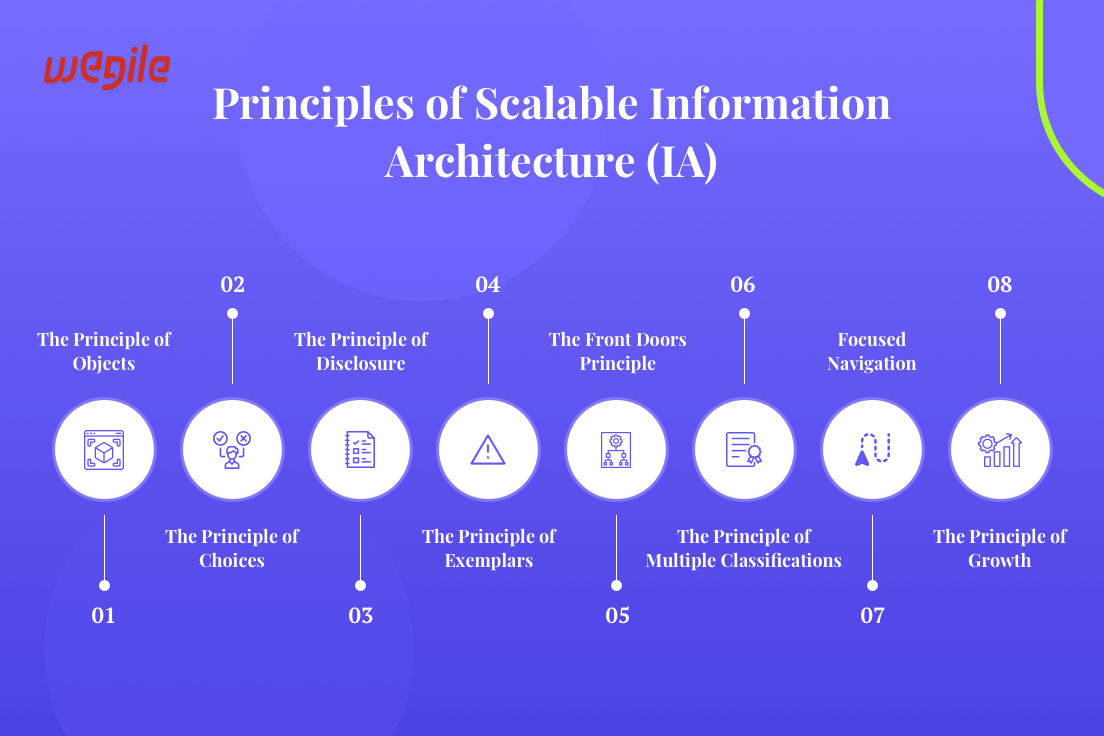
Now that we understand Information Architecture (IA), let’s dive deeper into its principles.
These principles serve as the fundamental pillars to make sure your IA design stays on course and
delivers optimal user experiences.
-
1. The Principle of Objects
In Information Architecture (IA), every piece of content or functionality should be treated
as an object that serves a clear, well-defined function for your application, like fitting
puzzle pieces together perfectly! -
2. The Principle of Choices
Your users shouldn’t feel overwhelmed with choices in an IA.
You should provide options in an easy-to-navigate and manageable fashion, like ordering at a
restaurant, with only a few choices but enough variety to suit different palates. -
3. The Principle of Disclosure
Information in the app should be revealed progressively to avoid overwhelming users with data
and prevent user disengagement.Think of peeling an onion; layer upon layer should be gradually revealed so as to keep users
engaged without overloading them with too much information at once.This keeps users engaged while simultaneously limiting information overload.
-
4. The Principle of Exemplars
Present examples to your users to assist their understanding while they access your app.
Much like clothing stores display outfits on mannequins, your app could display exceptional
content or actions to assist users and show examples for them to refer back to later on. -
5. The Front Doors Principle
Not all users enter your app through its main page. Therefore, architecture information
should offer multiple entry points.It’s similar to the side entrances of a house, so users can quickly gain access to what they
require. -
6. The Principle of Multiple
ClassificationsDon’t limit yourself to just one method for organizing content.
Your users might have different mental models of accessing similar material – just as road
signs point toward their destination in an urban environment.Provide your users with multiple paths that lead directly towards it so users have a smooth
user experience. -
7. Focused Navigation
To keep navigation clear and straightforward, avoid too many detours or dead ends – like
driving on an expressway with well-marked exit signs. -
8. The Principle of Growth
Your IA should be fluid and adaptable. Just as cities grow over time, so should your app
accommodate new content without creating chaos or disarray.Now, let’s put these principles together – these components form an IA that feels like a
concerto!Imagine you are planning an elaborate dinner party, with various courses carefully organized
so they complement one another for an exquisite dining experience.By applying these IA principles in digital environments, you are effectively designing an
intuitive app.This way you’re ensuring an app interface, where users can navigate easily while discovering
content intuitively.
Key
Components of Scalable Information Architecture
Now that we understand the fundamental principles of Information Architecture (IA), let’s examine its
core components.
These components are like building blocks for a soaring skyscraper – so your mobile app can reach new
heights without crumbling under its own weight. Let’s have a look at them!
-
1. Content Organization and
CategorizationIn the same way, an IA can ensure each piece fits neatly within one or more well-established
sections of the app!Imagine that your app’s content is like an immense library. In this library, various genres
are arranged into categories for easy user navigation.For instance, a news app may group articles into political, sports, or entertainment topics.
This way, users are able to quickly locate what interests them without wading through pages
of irrelevant info. -
2. Navigation and Menu Design
Your app’s navigation system serves as its GPS. Therefore, it should be user-friendly and
intuitive, seamlessly leading users to their destination with ease.Consider clear labels, hierarchical menus, and an uncluttered interface as ways of improving
the app’s effectiveness.Now, imagine that you’re driving through an urban city with well-marked road signs – that’s
the kind of guidance your app’s IA will offer its users! -
3. Search Functionality
Search is often a key feature that your users will look in your app for when they need
something quickly.An IA that incorporates robust search features allows them to locate particular pieces of
content or features quickly.Think of the search function as the index in a book!
-
4. User-Centric Design Principles
The first and foremost thing your IA should prioritize in your app is the user’s needs and
preferences.Conduct in-depth user research in order to gather more insight into user behaviors and
expectations.Make use of user-centered design methods so your app aligns with how its target market
interacts. -
5. Consistency and Adaptability
Just like a well-structured building stays intact in all weather conditions, an IA must also
remain consistent and adaptable over time.A scalable IA should accommodate these changes without becoming overwhelming for its users.
How to Design the Information Architecture of Your
Mobile App?
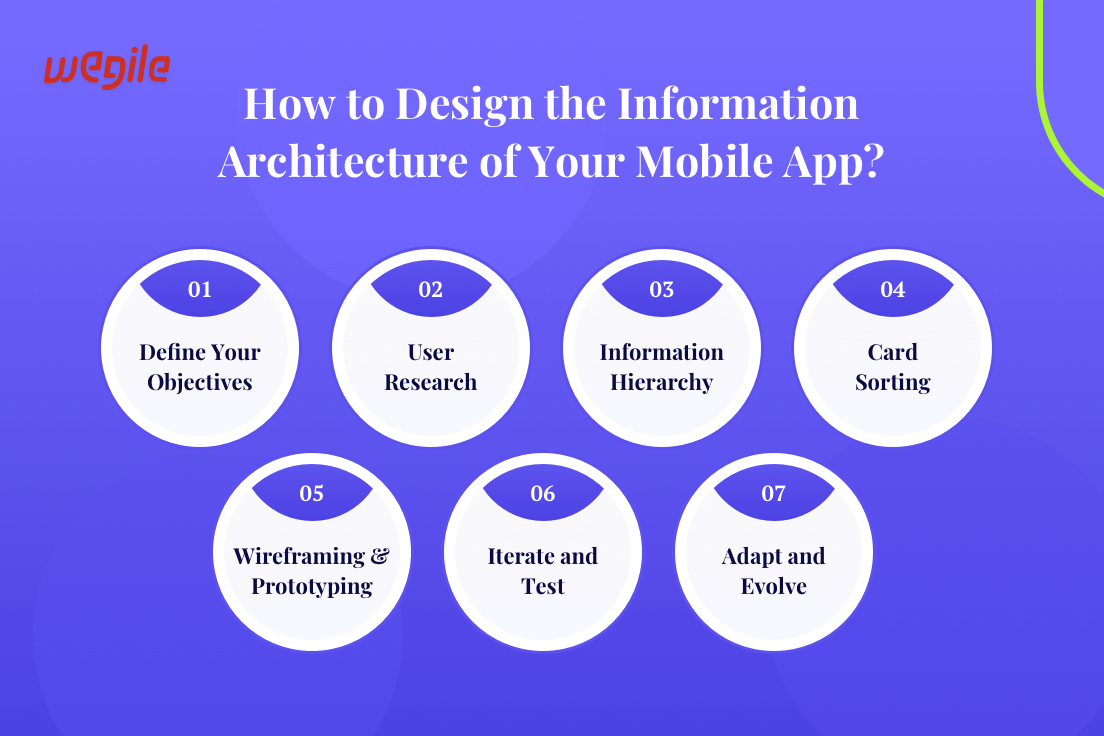
Designing a solid Information Architecture (IA) for your mobile app is like constructing a
well-organized city.
Every street, building, and signpost must serve a purpose and lead users to their desired
destinations. Let’s break down the IA design process into a detailed, step-by-step guide:
-
Step 1: Define Your Goals and Priorities
Before embarking on your journey in designing the Information Architecture UX of your mobile
app, it’s vitally important that you set clear objectives.Consider what goals your app hopes to meet.
Ask questions like: Who are your target audiences, and what are their unique needs and
preferences?At its heart, this initial phase is akin to setting out coordinates on a map before embarking
on any journey.An IA provides you with a sense of direction, helping you tailor your IA to meet the goals
and expectations of your app specifically.It’s just as knowing where you’re heading towards ensures a more pleasant journey.
-
Step 2: User Research
Undergoing extensive user research can help you craft IA designs that best address its target
audience. It is a key consideration for creating successful designs of any IA system.Gaining this insight is paramount if you wish to craft effective IA designs tailored
specifically for them.Employ surveys, interviews, and usability testing as tools for gathering insights.
It’s like asking locals for directions when visiting an unfamiliar city. It’s because they
have first-hand knowledge of any shortcuts or hidden gems as well as effective routes across
the terrain.In the same way, user research provides you with all of the knowledge necessary to design an
IA that leads users directly to their desired destinations within your app. -
Step 3: Information Hierarchy
A key part of IA design involves developing an information hierarchy.
This hierarchy can help you prioritize content and features according to their significance,
relationships with each other, and potential risks they pose for visitors.Imagine organizing items on store shelves; those most requested should be easily reachable
and at eye level.Your IA should ensure that users can easily and quickly gain access to content or functions
they find essential.Designing an app around your user needs and expectations means ensuring their app experience
is an effortless and harmonious journey. -
Step 4: Card Sorting
Card sorting is an efficient method for organizing content logically within an IA.
Assimilate user feedback in order to categorize and structure information effectively.
Consider it like piecing together a puzzle – place elements strategically so they make sense
for users.Card sorting ensures your IA aligns with how your target audience perceives and navigates
information, creating a user-friendly and intuitive experience for your app users.Once you understand how users naturally categorize and access information, you can tailor
your IA so it aligns with their cognitive frameworks- improving the overall usability of
your mobile app. -
Step 5: Wireframing and Prototyping
Wireframing and prototyping are key steps in the architecture information design process,
offering visual depictions of your app’s layout and navigational elements.These blueprints serve as architectural plans, providing users with a detailed picture of how
they will engage with your IA.As with architecting, these wireframes and prototypes help map out user journeys within your
app to ensure an enjoyable user experience.Sketches provide the foundation of any IA design, helping you visualize and revise its
structure before its actual implementation. -
Step 6: Iterate and Test
Iteration and testing are integral parts of IA design. Once an initial version of your IA has
been developed, gathering user feedback and input is vital to ensure the app’s
effectiveness.This feedback loop ensures that your IA aligns more closely with user requirements and
preferences.Imagine taking your vehicle out on test-driving to optimize its ride for comfort. Make
necessary adjustments as per your need so as to achieve smooth sailing.User testing enables you to identify pain points and usability issues so you can refine your
IA for maximum user satisfaction.An iterative process ensures that your IA adapts and transforms in response to user demand
and mobile app development trends. -
Step 7: Adapt and Evolve
A dynamic IA isn’t static. As your app expands with additional content or features being
introduced, its IA should adapt and evolve accordingly.Imagine renovating your house to meet the growing needs of a growing family. In much the same
way, IA should grow and adapt as your app’s needs do.Your IA should remain user-friendly over time to avoid user confusion and dissatisfaction.
With its flexible nature, adaptable interfaces help ensure efficiency without confusing
users further down the road.Future-proof your IA so it can expand with your app’s growth while accommodating changes and
providing users with a positive user experience.Hence, Flexibility and adaptability are keys to long-term IA success.
Wrapping Up
So here we end with an insightful guide on Scalable Information Architecture.
As we traversed through the vast world of IA, you have gained insights into its core principles and
how you can implement a user-oriented IA for your app.
Remember, IA is more than just a framework; it’s the key to unlocking exceptional user experiences.
By prioritizing user needs and adopting IA principles, your chances for success in mobile app
development can increase significantly.
Reach us, Wegile, as here we will assist you with building mobile apps that not only meet user
expectations but exceed them!
Leave a Reply