In the modern era of digitalization, establishing a robust presence online is essential. Magento, a
prominent e-commerce solution, plays a vital role in this context. Magento E-commerce Development
stands out as a critical framework in the online space. What truly sets a business apart is how it
uses platforms like Magento to stay ahead. Magento E-commerce Development isn’t just about building
a website; it’s about crafting a unique online space that helps your business shine. Hence, Magento
is not just a platform; it’s a key to unlocking your business’s potential online. In this blog, we
will discuss why Magento is a game-changer in e-commerce. We’ll look at how Magento helps companies
to grow, adapt, and excel in the competitive digital marketplace. So whether you’re a budding
entrepreneur or a seasoned business leader, stay tuned as we unravel Magento’s critical role in
succeeding in the eCommerce landscape!
Understanding Magento
Magento is not merely
a platform for launching an e-commerce store; it’s a comprehensive ecosystem equipped with advanced
technical features designed to empower businesses in the digital marketplace. What sets Magento
apart is its open-source nature, offering unparalleled customization and flexibility. This allows
companies to tailor their online stores to precise specifications, accommodating unique brand
identities and customer experiences.
For businesses aiming to excel in the competitive online shopping sphere, mastering Magento’s
technical intricacies is crucial. It’s not just about listing products online; it’s about leveraging
Magento’s advanced features to elevate your brand, enhance customer engagement, and drive growth. In
the later sections, we’ll take a closer look at Magento. We’ll explore how it can really make a
difference for your business and help you stand out in the online world.
Benefits of
Magento Ecommerce Development
Magento isn’t just a popular framework; it’s a game-changer in the world of eCommerce. Its benefits
are vast, combining technical sophistication with user-friendly features. Let’s break down these
benefits, keeping them detailed yet easy to grasp.
-
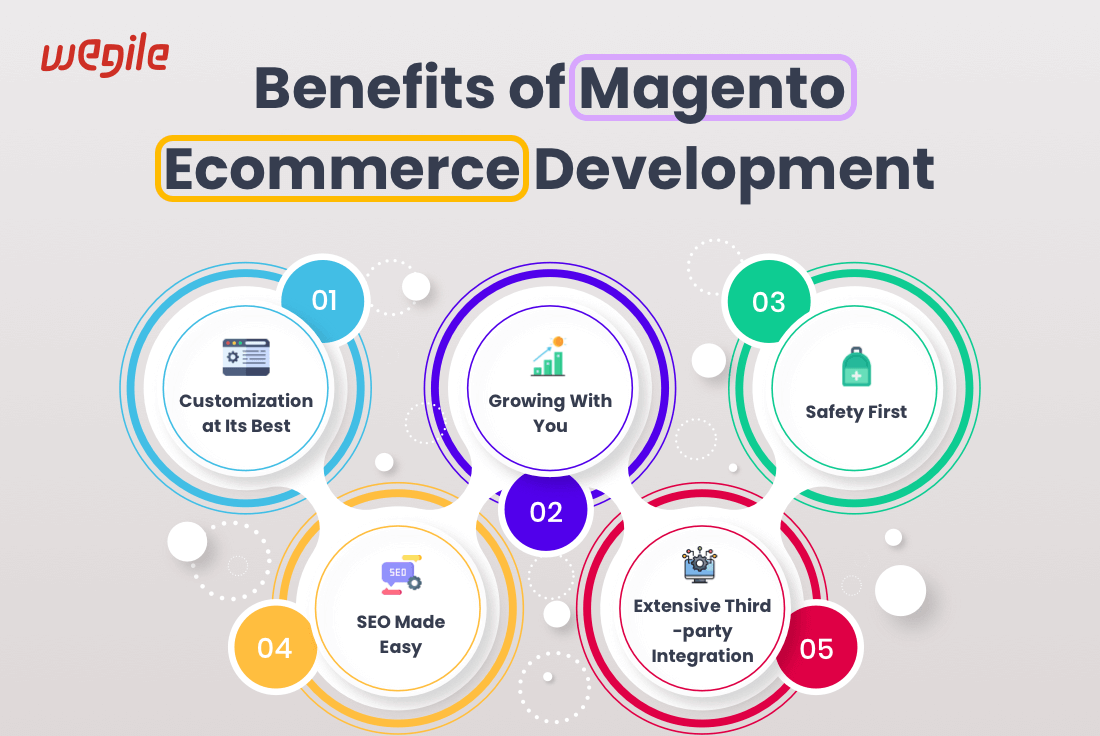
1. Customization at Its Best
Magento is like a digital playground for businesses. Its open-source nature allows you to
tweak almost everything. Imagine you sell custom-made gifts; with Magento, you can design
your site to let customers personalize their orders right there. It’s this level of
customization that sets Magento apart, making your online store as unique as your products. -
2. Growing With You
One of Magento’s standout features is its ability to grow with your business. It’s built to
handle more products, more traffic, and more sales as your business expands. For example, if
your small home-based business suddenly goes viral, Magento can handle the surge without
skipping a beat. This scalability is a big plus for businesses planning for long-term
growth. -
3. Safety First
In the online world, security is crucial. Magento shines here with features like secure
payments and data protection. It’s constantly updating its security, keeping your store safe
from new threats. Think of it as having a top-notch security system for your online store,
ensuring that your customer’s data and your reputation are well-protected. -
4. SEO Made Easy
Magento is also great for getting your store noticed on search engines. It has built-in tools
that help you optimize your site for Google and others. For example, if you sell
eco-friendly products, Magento can help you appear higher in search results when people look
for green options. This built-in SEO is like having a marketing assistant working 24/7 to
boost your online presence. -
5. Extensive Third-party Integration
Lastly, Magento’s ability to integrate with various third-party apps and services is a big
win. Whether it’s adding a new payment method or syncing with a CRM system, Magento makes it
easy. This means you can connect tools you already use, like email marketing software or
customer analytics, directly to your store. It’s about making your online business as
efficient and connected as possible.
Steps
Involved in Magento Ecommerce Development
-
1. Strategic Planning and Analysis
Before diving into development, it’s crucial to plan. This first step is all about
understanding what your business wants to achieve with its online store. Think of it as
setting the stage for your Magento site. It involves figuring out who your customers are,
what they need, and how your online store can meet those needs. For instance, if you have a
global target audience, you might want to focus on features like multiple languages and
currencies. This planning phase is like drawing a map for your journey with Magento – it
guides you in every decision and steps you take. -
2. Designing a User-Centric Interface
The next big step is designing your Magento store. This is where creativity meets
functionality. A good design isn’t just about looking pretty; it’s about making it easy and
enjoyable for customers to shop. Imagine creating a store that not only catches the eye but
also makes shopping effortless and fun. Whether it’s choosing colors, layouts, or navigation
menus, every design element should aim to provide a great experience for your users. A
well-thought-out design can make a huge difference in keeping customers engaged and coming
back. -
3. Custom Development and Integration
Now comes the part where your store really starts to take shape – custom development. Magento
is known for its flexibility; here’s where you can use it to your advantage. At this point,
the focus shifts to customizing Magento to align perfectly with your business’s unique
requirements. This could mean designing bespoke product catalogs or implementing specialized
shipping configurations. Custom development gives you the freedom to tweak and refine your
e-commerce platform with precision. Beyond aesthetic adjustments, it’s about integrating
Magento with essential systems such as CRM or inventory management, streamlining your
operations for optimal efficiency. -
4. Rigorous Testing for Quality
AssuranceTesting is a big deal in Magento development. It’s like giving your site a thorough check-up
before it goes live. This step is all about making sure everything works perfectly – no
bugs, no glitches, just a smooth shopping experience for your customers. Think of it like
test-driving a car before you buy it. You want to be sure it runs smoothly and is safe. This
includes checking how fast pages load, ensuring all links and buttons work, and making sure
the site is secure from any online threats. It’s crucial because you want your customers to
have a great experience every time they visit your store. -
5. Deployment and Going Live
After testing, it’s time to launch your Magento site. This is when your online store opens
for business. But it’s not as easy as it seems; it needs careful planning to make sure
everything goes smoothly. You want to make sure that the transition to going live doesn’t
cause any problems, like website downtime or lost data. It’s like opening a new physical
store – you want everything to be perfect for your first customers. This stage includes
final adjustments, moving all your data to the live site, and double-checking that every
feature works as it should. -
6. Continuous Maintenance and
OptimizationLaunching your Magento store isn’t the end of the journey. Just like any store, it needs
regular care to keep it running well. This means updating it with the latest features,
fixing any issues that pop up, and making sure it stays fast and easy for customers to use.
It’s also about looking at how customers are using your site and making improvements based
on what they need and want. This could mean adding new features, tweaking the design, or
updating products. Think of it as keeping your store fresh and exciting – it’s what keeps
customers coming back.
Features of
Magento Ecommerce Development
-
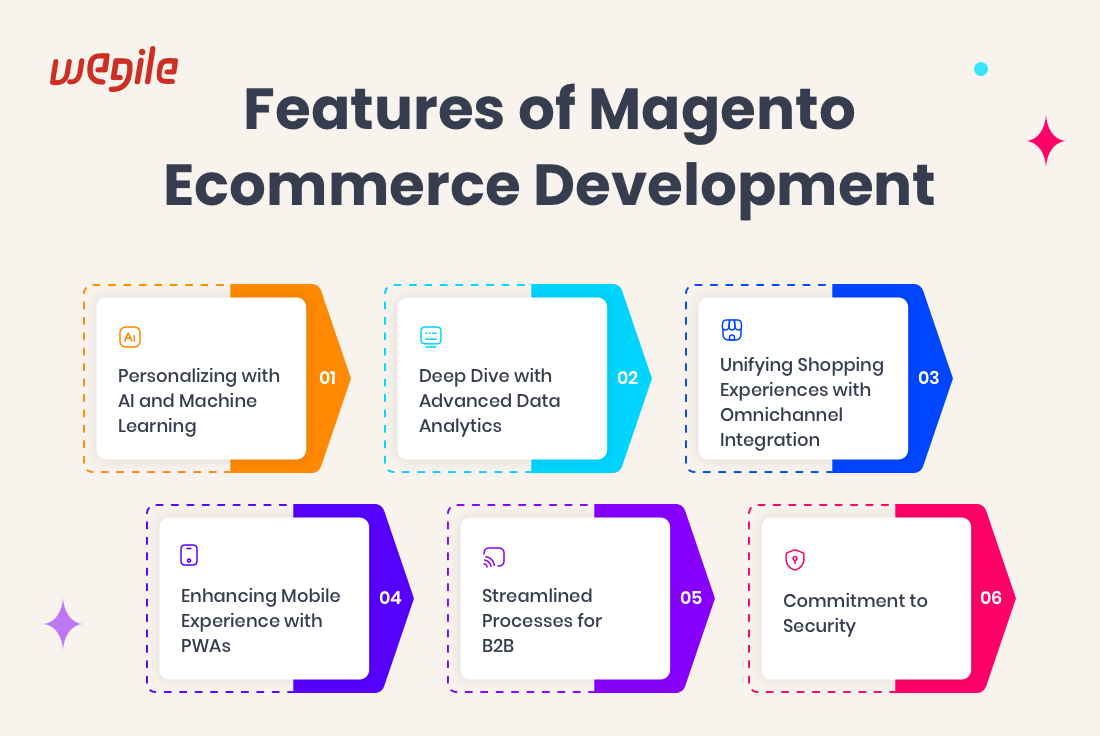
1. Personalizing with AI and Machine
LearningMagento’s use of artificial intelligence (AI) and machine learning (ML) is a big leap
forward, yet it’s often not talked about enough. These technologies make your online store
advanced. They learn what your customers like by looking at their shopping habits and then
suggest products they might like. It’s like having a personal shopper for each customer,
helping them find exactly what they want, which can lead to more sales and happier
customers. -
2. Deep Dive with Advanced Data
AnalyticsMagento goes beyond basic number-crunching with its advanced analytics tools. This feature is
like having a super-smart assistant who helps you understand your customers better. It tells
you which products are hot sellers, what times of day people shop the most, etc. This kind
of information is gold for a business. It helps you make intelligent decisions about what to
stock up on and how to plan your marketing so you’re always one step ahead. -
3. Unifying Shopping Experiences with
Omnichannel IntegrationMagento’s omnichannel capabilities are a game-changer, yet they don’t always get the
spotlight they deserve. This feature lets your customers have a seamless shopping
experience, whether they’re on a phone, computer, or even in a physical store. For example,
someone could start shopping on their phone, then switch to a laptop, and everything they
added to their cart is still there. It makes shopping smooth and easy, which customers love. -
4. Enhancing Mobile Experience with
Progressive Web Apps (PWAs)Magento’s support for Progressive Web Apps (PWAs) is like giving your website superpowers. PWAs allow your website to
act like an app on a phone or tablet, making it faster and more user-friendly. This is great
for customers who shop on their mobile devices. They get an app-like experience without
having to download anything. Businesses also benefit, as PWAs can lead to more visits and
keep customers engaged for extended periods. -
5. Streamlined Processes for B2B
Magento’s features for business-to-business (B2B) transactions are often overlooked but are
incredibly powerful. It has tools that make handling large orders easier, setting special
prices for different customers, and quickly filling out order forms. This is especially
useful for businesses that sell to other companies. For example, a supplier can offer
personalized prices to their regular retailers, automate large orders, and make the buying
process smoother and more efficient. -
6. Commitment to Security
While Magento’s strong security is well-known, its ongoing updates and improvements are worth
a special mention. Magento is constantly beefing up its security to protect against new
threats. This includes two-factor authentication, which adds an extra layer of security and
ensures it meets all the latest payment security standards. Keeping customer data safe is a
big deal, and Magento’s commitment to security helps businesses build trust with their
customers.
Challenges in
Magento E-commerce Development
-
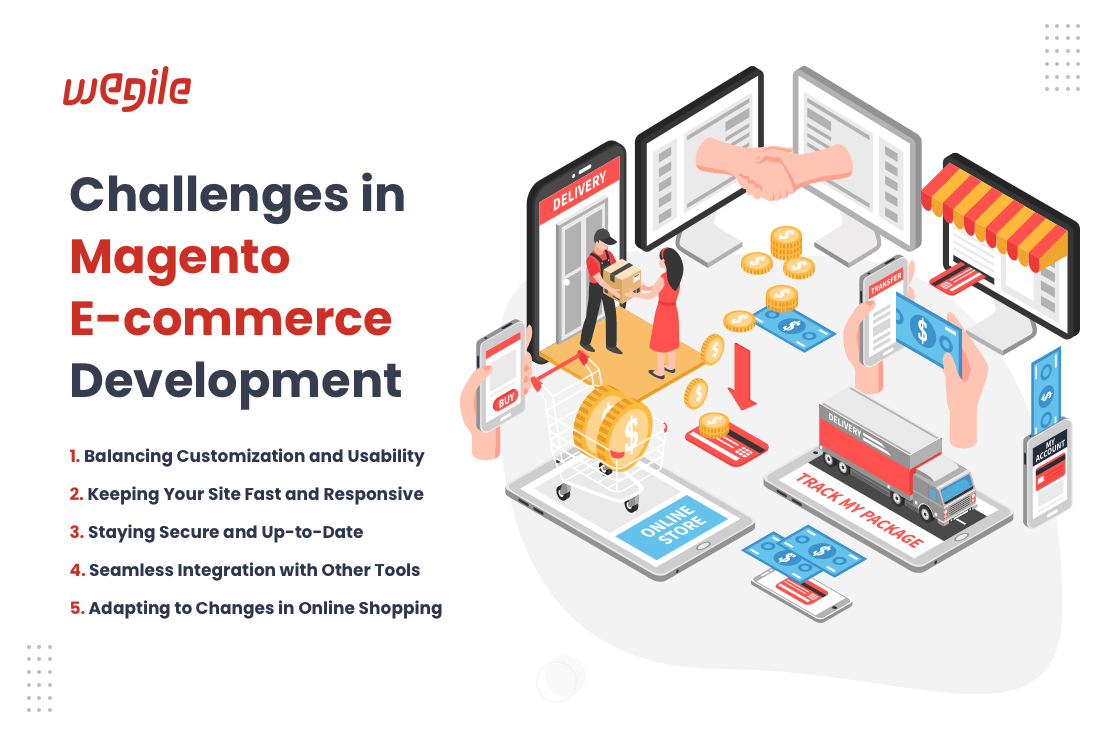
1. Balancing Customization and Usability
Magento’s customization is great, but it can get tricky. The more custom features you add,
the more complex your website becomes. This can be overwhelming, especially if you’re new to
Magento or not very tech-savvy. For instance, adding lots of unique features might make your
website slow, which isn’t suitable for your visitors or your search engine ranking. It’s
important to find the right balance between making your site unique and keeping it
user-friendly. -
2. Keeping Your Site Fast and Responsive
With all its cool features, Magento can sometimes run slowly, especially if your online store
has a lot of products or custom functions. No one likes a slow website, so it’s essential to
keep things running smoothly. This means regularly checking your website’s speed and making
adjustments, like optimizing images or using caching, to make sure your customers have a
fast and enjoyable shopping experience. -
3. Staying Secure and Up-to-Date
Magento is known for being secure, but it needs regular updates to stay that way. Since
Magento is open-source, it’s always getting updates to fix security issues. However, keeping
up with these updates can be a challenge, especially if your website has a lot of custom
features. Skipping updates can leave your website at risk, so it’s crucial to stay on top of
them to keep your customers’ data safe. -
4. Seamless Integration with Other Tools
Magento, as a platform, can easily integrate with different apps and tools, which is great!
But getting these integrations to work smoothly can be challenging. Sometimes, Magento
integration might not work well with other software, which can cause problems on your
website. To avoid this, you need to carefully plan and test how Magento integrates with
other systems. This ensures everything works together nicely, giving your customers a good
shopping experience. -
5. Adapting to Changes in Online
ShoppingThe world of online shopping is constantly changing, and keeping your Magento site up-to-date
can be difficult. This means staying in tune with new shopping trends, payment methods, and
ways to market your products. It’s essential to be flexible and ready to add new features or
change your approach to keep up with what customers want and stay ahead in the market.
Tackling these challenges is critical to making the most of Magento. It’s about using its
strengths wisely while handling its complexities and staying up-to-date in the fast-moving
world of e-commerce.
Wrapping Up
As we conclude our exploration of Magento E-commerce Development, it’s evident how pivotal and
adaptable Magento is for online businesses. Here at Wegile, we’ve delivered a multitude of projects
that showcase the strengths of Magento. As a top Magento website development
company, our approach goes beyond technical expertise since we tailor each project to the
specific needs and ambitions of our clients.
Our journey in the e-commerce realm has reinforced the importance of a platform like Magento, which
offers not just technical excellence but also the flexibility to meet diverse business challenges.
For those contemplating Magento for their online ventures, we at Wegile are equipped to bring
your vision to life. We believe in creating e-commerce solutions that are not just functional but
also innovative and aligned with your business strategy. Reach out to us, and let’s work together to
make your e-commerce project not just a success but a benchmark in the industry.
Leave a Reply