AI isn’t a sci-fi concept; it is real and is shaking up lives. It has swiftly incorporated into business
across America, changing how things work at every level in each domain. But with so much AI discussion,
it’s easy to feel lost in amazement at what it truly means and how it impacts real businesses. So, how
can companies cut through the hype and focus on AI technologies that matter? Is AI worth investing in or
merely a trend? These questions have left many CEOs and business owners confused about whether they should adopt it
or stay with what they know. This blog guides you through the real-world impact of AI in the US and the technologies
that are transforming several industries. We will explore how AI is helping organizations scale smarter,
streamline processes, and engage customers in new ways.
A Brief History Of AI Development in the U.S
From early computational and cognitive research, the US has led the development of AI. Artificial
Intelligence as a concept gained momentum in the 1950s when John McCarthy and Marvin Minsky established and formalized
ideas around machine learning and intelligence at American
colleges. Early U.S. government investment, particularly through DARPA, helped bring AI from theory to
practice, laying the framework for future progress. Over the decades, natural language processing and
machine learning have helped the U.S. lead the field of AI. Collaboration among research institutes,
industry leaders, and government support has made AI central to the nation’s technological progress.
The Origins of AI and Government’s Role
AI’s U.S. journey began with strategic government participation. DARPA financed the 1960s
“Speech Understanding Research” project, one of the
first attempts to teach computers to comprehend human language. AI’s fundamental principles were
developed by universities like MIT and Stanford. Early achievements were driven by DARPA efforts to
improve national security and create autonomous systems that demonstrated AI’s potential. This
collaboration between government organizations and academics provided access to resources, innovation,
and breakthroughs that made the U.S. an international leader in AI development.
Key
Milestones and Breakthroughs in the U.S. AI Landscape
Over the years, the United States has set the standard for AI with a number of groundbreaking
achievements. IBM’s Deep Blue defeated world chess champion Garry Kasparov in 1997, demonstrating
machine learning’s power. Following this, Google introduced “deep learning” neural networks, which
transformed image and speech recognition. Watson won “Jeopardy!”
in 2011, exhibiting advancements in natural language
processing. Deep learning and generative AI have lately offered even more powerful AI technologies,
transforming various sections. This shows the U.S.’s dedication to pioneering AI innovations that have
shaped global industry.
AI’s
Growth Trajectory in the U.S: Key Drivers and
Trends
AI has grown rapidly in the US for several reasons. Recent advances in
computing power and algorithms have made AI applications easily accessible and scalable. A wealth of
data from IoT devices, social media, and digital interactions has made AI smarter, turning raw data into
useful insights. Cloud computing has further driven AI adoption by providing powerful processing
capabilities without the need for heavy infrastructure costs. Also, venture capitalists and IT giants
have funded AI research and entrepreneurship, cementing AI’s place in the business landscape.
Figures
Highlighting the Use of AI in the U.S.
Recent studies show that various American businesses use AI. Following the launch of ChatGPT, 73% of
American businesses have used AI in some capacity in 2023, with 54% utilizing GenAI
(PWC). Artificial intelligence is anticipated to have a large
economic
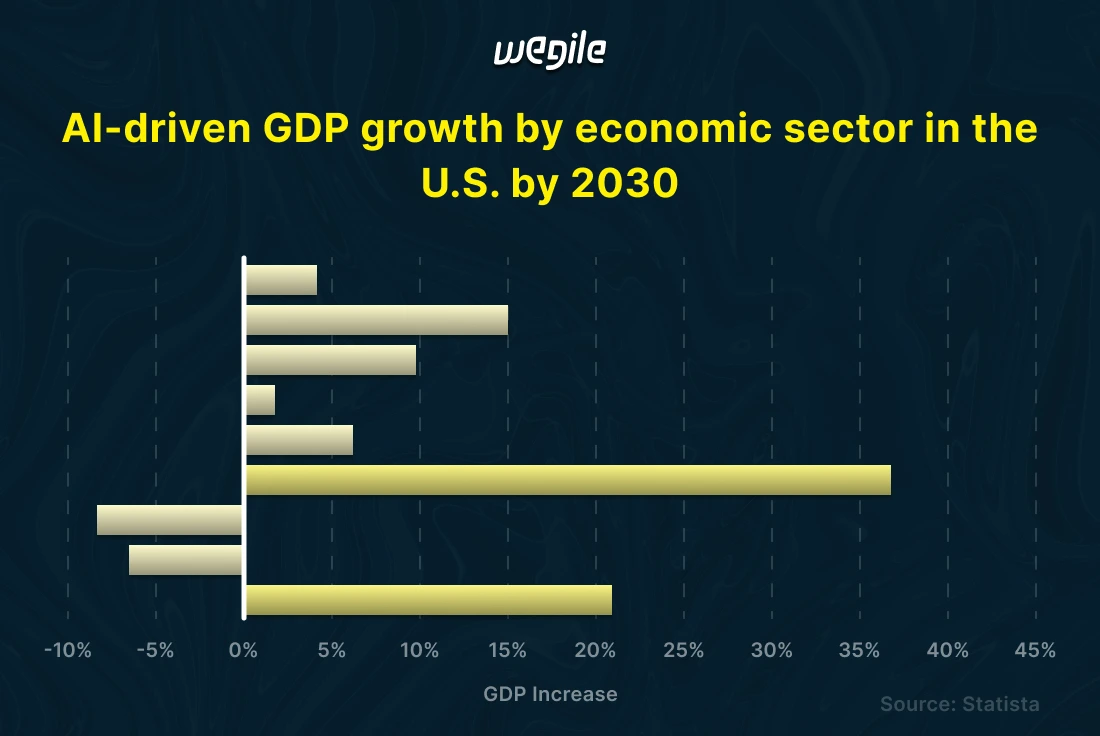
influence, adding 15% to the US GDP by 2030 (Statista). Nearly 65% of organizations use generative
AI in sales, customer service, and supply chain, according to McKinsey. As a result of enhanced operational
efficiency and customer engagements, revenue has increased by around 5%.
The Rise of AI Startups and
Corporate Investments
Companies and investors are pouring resources into U.S. AI firms because of their transformative
potential. Major firms like Google, Microsoft, and Meta significantly invest in AI-focused businesses,
sparking innovation in healthcare and retail. These firms receive significant
venture capital funding, making the U.S. AI market the most funded globally. This significant financial
backing encourages experimentation and rapid progress, solidifying the U.S.’s position as a leader at
the forefront of AI advancement.
Data
Explosion and AI Advancements
The explosion of data generated by Internet of Things (IoT) devices, social media, and online
interactions is driving the expansion of AI in the United States. With more data to analyze, AI systems
are more accurate and adaptive. AI improves continuously with this vast data flow, enabling predictive
analytics, tailored experiences, and automation. The abundance of data in the United States is driving
innovative AI applications in fields as diverse as healthcare and finance, creating an ideal setting for
businesses to flourish.
Must Read: How to Build Generative AI Apps: A Comprehensive Guide
Sectors Transformed by AI in the United States
U.S. sectors are being transformed by AI, improving efficiency, precision, and innovation. Healthcare
and retail are using AI to improve procedures and gain smarter insights. Each industry is experiencing
transformative benefits, whether it’s patient outcomes in healthcare, fraud detection in finance, or
tailored shopping experiences in eCommerce. This section discusses these changes and practical AI
applications that increase productivity and growth.
1. Healthcare
AI is improving healthcare diagnostics and treatment with astonishing precision. Predictive algorithms
can now detect diseases early, improving cancer and heart disease diagnosis. Radiologists can now
conduct faster, more accurate diagnoses with the help of AI-driven imaging tools that detect even the
most subtle abnormalities. AI can also help with personalized medicine by tailoring treatment strategies
to a patient’s specific genetic composition. In addition to patient care, AI helps hospitals manage beds
and staff, improving processes and wait times. Thus, AI enables healthcare providers to enhance results
and maximize resources, which is good for patients and medical teams.
2. Finance
When it comes to decision-making, customer experience, and data security, the financial sector is AI dependent. AI algorithms
help banks to assess risk in real time and make data-driven loan and investment choices. Predictive
analytics give clients personalized financial advice, while chatbots and virtual assistants answer
common questions. Through pattern analysis, AI alerts banks and customers to suspicious transactions,
ensuring security. This proactive fraud prevention protects assets and creates trust in digital
financial services, boosting customer loyalty.
3. Retail and E-commerce
E-commerce and retail businesses employ AI to tailor customer experiences and optimize logistics. AI
uses browsing history and past purchase data to offer products based on user preferences, increasing
sales and engagement. AI also contributes towards elevating supply chain management. It improves inventory, predicts demand, and
automates warehouse activities, reducing supply chain inefficiencies. The availability of chatbots and
customer care systems powered by AI guarantees a flawless shopping experience at every time. Merchants,
with the support of data insights, can improve efficiency, keep inventory under control, and create
personalized shopping experiences that keep customers coming back.
4. Manufacturing and Supply Chain
The use of AI for predictive analytics and automation in manufacturing has substantial benefits. Early
wear detection using AI systems reduces downtime and extends the life of machinery. Another advantage is
the streamlining of quality control. This is because AI’s flaw detection abilities are far more accurate
than those of human inspectors. Supply chain management uses AI to optimize production and delivery
schedules for fast logistics. AI integration into manufacturing and supply chains improves operational
efficiency, costs, and product quality. This makes AI a valuable asset in attaining a competitive edge.
Must Read: Exploring Top 13 Use Cases for Generative AI
Wrapping Up
As we conclude our conversation about AI’s rise in the U.S., it’s clear that businesses are experiencing
a tsunami of innovation. From automating activities to improving consumer experiences, AI is here and
making a difference. While watching this transition is fascinating, entering the AI world for the first
time might be stressful for businesses.
That’s why we’re here to support you! Here at Wegile, we’re not merely knowledgeable about AI; it’s our
daily reality. As a leading generative AI development business, we help you leverage AI’s potential by
creating tailored solutions that meet your needs. Our experts can design intelligent chatbots,
personalized content engines, and AI-driven analytics to transform your ideas into reality.
Ready to see how AI can help your business? Connect with Wegile today, and let’s create the future
together!
Leave a Reply