
We all know the tech industry moves faster than a speeding bullet. The perfect mobile app that you
spend months developing today could very quickly become outdated or overshadowed by the competition
tomorrow. That’s why outsourcing mobile app development has become such a necessity for companies
striving to stay ahead of the game. But, with so many potential partners and options to outsource
mobile app development Factors to Consider Before Outsourcing Mobile App Development hard to know
which direction to turn.
That’s why we here at Wegile created this article: to make your decision for mobile app outsourcing
that much easier. We’re like your trusty sidekick, always there to lend a helping hand when you need
it most. Think of outsourcing as your journey – we’re here to guide you through it every step of the
way. So, if you’re ready to take your app development into overdrive, strap on your seatbelt and get
ready for the ride of your life!
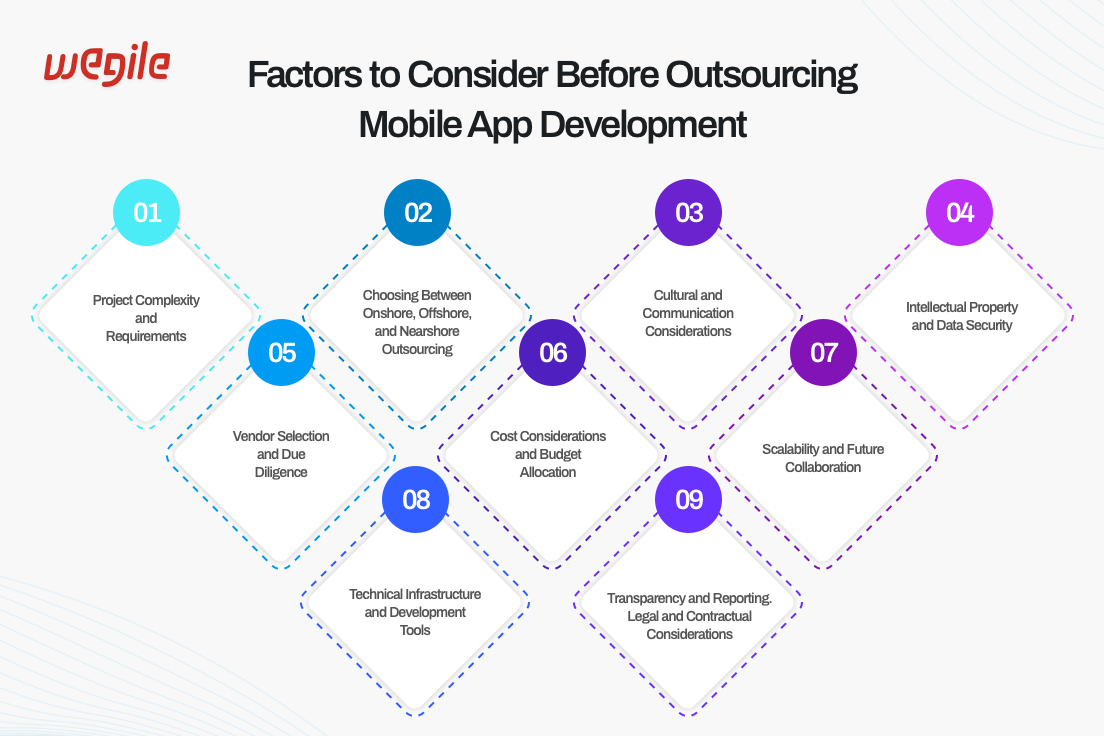
Factors to Consider Before Outsourcing Mobile App
Development
A.
Project Complexity and Requirements
Clearly Define App’s Functionality, Features, and User Experience:
-
Begin by creating a detailed blueprint of your mobile app development outsourcing’s purpose,
target audience, and core functionality. -
Articulate the features that the app must encompass to deliver a seamless and engaging user
experience.
Determine Technical Expertise Required for Development:
-
Assess the technical complexities your app demands, such as AI, AR, or IoT integration.
-
Identify if the mobile app outsourcing requires specific coding languages, frameworks, or
specialized skills.
Identify Potential Challenges or Unique Aspects of the Project:
-
Scrutinize the mobile app outsourcing project for any potential obstacles, technical challenges,
or distinctive features. -
Pinpoint any aspects that set your project apart and might require specialized handling.
B. Choosing Between Onshore, Offshore, and
Nearshore Outsourcing
Evaluate Benefits of Each Outsourcing Model Based on Project Needs:
-
Weigh the pros and cons of onshore, offshore, and nearshore options based on factors such as
budget constraints, required expertise, and timeline.
Consider Time Zone Differences and Their Impact on Communication:
-
Delve into the time zone disparities between you and the outsourcing location. Understand how
would overlapping work hours will impact mobile app development outsourcing with real-time
collaboration.
Assess the Political and Economic Stability of the Outsourcing Location:
-
Investigate the political climate and economic stability of the chosen outsourcing country to
minimize potential disruptions to your project.
C.
Cultural and Communication
Considerations
Understand Cultural Nuances That Could Affect Collaboration:
-
Dive into the cultural practices, communication styles, and work ethics of the outsourcing
team’s region to foster effective interaction.
Ensure That the Outsourcing Team Can Effectively Understand and Implement Your Vision:
-
Bridge potential gaps in understanding by providing detailed documentation and holding clear
discussions. -
Ensure your vision aligns with the outsourcing team’s interpretation.
Establish a Communication Protocol That Bridges Potential Language Barriers:
-
Set up a communication framework that includes preferred tools, regular meetings, and
reporting. -
Ensure all stakeholders are comfortable with the chosen communication methods.
D.
Intellectual Property and Data Security
Define Ownership and Usage Rights of the App’s Intellectual Property:
-
Clearly outline who will own the app’s source code, design, and any related intellectual
property in the contract.
Implement Data Security Measures to Protect Sensitive Information:
-
Collaborate with the outsourcing team to establish robust data protection practices that shield
sensitive user information and comply with data privacy regulations such as
GDPR(EU), and
Information Technology Act, 2000(India).
Include Legal Clauses in Contracts That Address Intellectual Property and Data Protection:
-
Engage legal professionals to draft contracts that address the ownership of intellectual
property and outline protocols for handling sensitive data securely.
E.
Vendor Selection and Due Diligence
Research Potential Outsourcing Partners Thoroughly:
-
Embark on a comprehensive research journey, studying the outsourcing companies’ reputation,
expertise, and client feedback. -
Check References, Review Portfolios, and Assess Past Client Feedback:
-
Connect with references provided by the outsourcing partner to gain insights into their
performance, communication, and ability to meet deadlines.
Evaluate the Vendor’s Technical Expertise, Industry Experience, and Development Methodologies:
-
Engage in detailed discussions with the outsourcing team to evaluate their familiarity with your
app’s technology stack, industry trends, and best practices.
F. Cost
Considerations and Budget
Allocation
Compare the Cost of Outsourcing with In-house Development and Other Alternatives:
-
Conduct a thorough financial analysis to compare the costs associated with outsourcing against
the expenses of in-house development or other solutions.
Factor in Additional Costs Such as Travel, Communication, and Potential Revisions:
-
Account for secondary expenses like travel for in-person meetings, communication tools, and
potential iterations in the development process.
Allocate a Budget That Covers the Entire Development Lifecycle and Potential Contingencies:
-
Set aside a budget that not only covers the primary development stages but also caters to
unforeseen challenges, revisions, and unforeseen costs.
G.
Scalability and Future Collaboration
Evaluate the Mobile App Outsourcing Vendor’s Capacity to Scale with Your Project’s Growth:
-
Discuss the mobile app development outsourcing team’s ability to accommodate increased project
scope or additional features as your app gains popularity.
Consider the Potential for Ongoing Collaboration Beyond the Initial App Development:
-
Envision the future and evaluate whether the mobile app outsourcing partner can be a long-term
collaborator for ongoing updates, improvements, and expansions.
Determine if the Mobile App Development Outsourcing Partner Can Provide Additional Services, Such as
Maintenance and Updates:
-
Ascertain if the mobile app outsourcing team can offer post-launch services such as bug fixes,
performance enhancements, and feature updates.
H.
Technical Infrastructure and Development
Tools
Ensure Compatibility Between Your Existing Technology Stack and the Outsourcing Partner’s Tools:
-
Confirm that your app’s tech stack aligns with the tools and frameworks that the outsourcing
team intends to use for development.
Discuss the Software Development Methodologies, Frameworks, and Tools They Will Use:
-
Engage in technical discussions to comprehend the development methodologies, programming
languages, and frameworks the outsource mobile app development plans to implement.
Address Potential Integration Challenges with Existing Systems:
-
Anticipate potential integration challenges that might arise when connecting the app to your
existing systems or third-party APIs. -
Collaborate with the outsourcing team to devise strategies to overcome these challenges.
I.
Transparency and Reporting
Establish a Reporting Structure to Monitor Project Progress and Milestones:
-
Set up a clear reporting hierarchy for mobile app outsourcing that defines how project progress,
milestones, and potential challenges will be communicated.
Request Regular Updates on Development Status, Challenges, and Achievements:
-
Foster transparent communication by requesting consistent updates on development status, along
with insights into any obstacles encountered.
Define How Frequently and Through What Channels You Will Receive Progress Reports:
-
Specify the frequency of progress reports and the preferred communication channels, ensuring
seamless information exchange.
J. Legal and
Contractual Considerations:
Engage Legal Experts to Draft Comprehensive Contracts and Agreements:
-
Collaborate with legal professionals to draft contracts that protect both parties’ interests,
outline responsibilities, and establish legal frameworks.
Clearly Outline Responsibilities, Deliverables, Timelines, and Payment Terms:
-
Provide a detailed breakdown of each party’s responsibilities, project deliverables, expected
timelines, and the schedule of payments for this outsourced mobile app development project.
Include Clauses That Cover Potential Disputes, Termination, and Resolution Processes:
-
Anticipate potential scenarios and include clauses that address dispute resolution mechanisms,
contract termination, and problem-solving procedures.
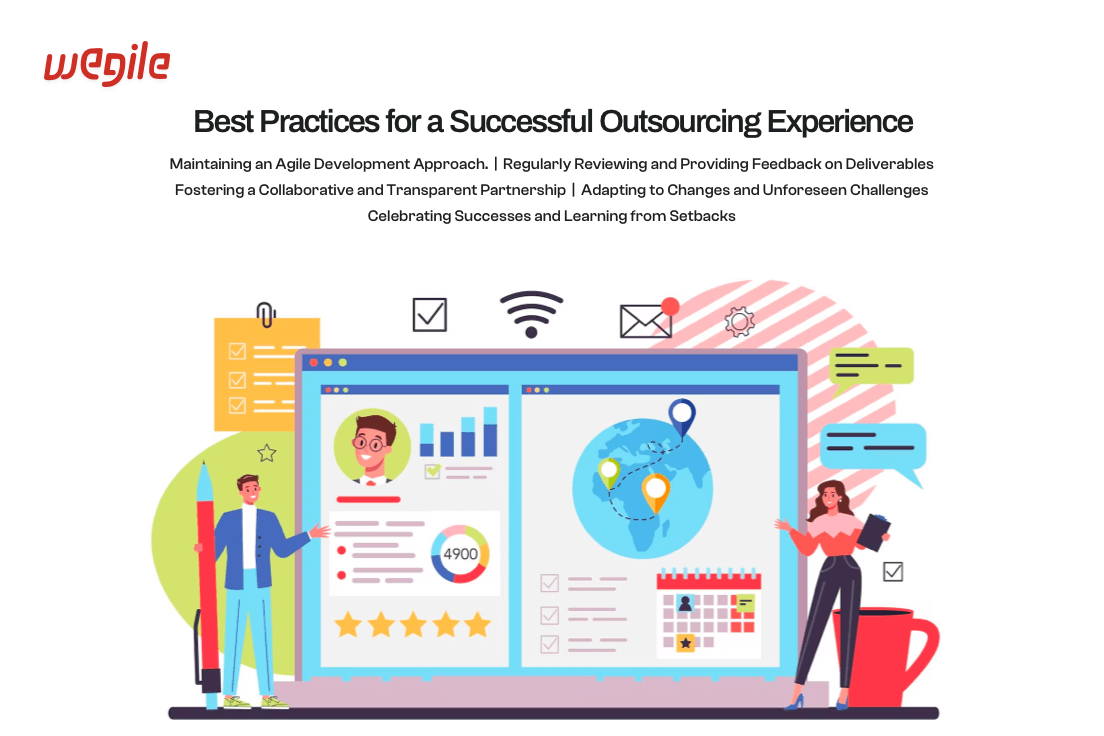
Best Practices for a Successful Outsourcing
Experience
Outsourcing mobile app development can be highly rewarding if approached strategically and
thoughtfully executed. Here are some essential best practices to ensure a smooth and productive
mobile app outsourcing experience:
A.
Maintaining an Agile Development
Approach
Iterative Progress: Adopt an agile
development methodology that breaks the project into smaller iterations, allowing for continuous
improvement and refinement.
Frequent Milestones: Break the project into manageable milestones with clearly defined objectives.
Regularly reassess and adjust priorities to stay aligned with evolving goals.
Regular Sprint Meetings: Conduct frequent sprint meetings with the outsourcing team to assess
progress, set goals, and prioritize tasks for upcoming iterations.
Collaborative Decision-Making: Encourage collaboration between your team and the outsourcing team in
making decisions about feature prioritization and adjustments.
B. Regularly Reviewing and Providing
Feedback on Deliverables
Scheduled Reviews: Set up regular review sessions to assess the progress of deliverables. This allows
you to catch any deviations from your expectations early and address them promptly.
Constructive Feedback: Provide specific and constructive feedback. Highlight what works well and
where improvements are needed. Clear feedback aids the outsourcing team in addressing issues
promptly.
Alignment with Objectives: Ensure that each deliverable aligns with your project’s overall objectives
and meets your quality standards. This prevents deviations that might emerge if not monitored
closely.
C. Fostering a Collaborative and
Transparent Partnership
Open Communication Channels: Establish open lines of communication that facilitate easy interaction
between your team and the outsourcing partner.
Shared Goals: Ensure a shared understanding of the app’s goals, user personas, and overarching vision
between your team and the outsourcing partner.
Collaborative Tools: Leverage collaboration tools and project management platforms to facilitate
real-time updates and efficient communication.
Regular Meetings: Schedule regular virtual meetings to discuss progress, clarify doubts, and
brainstorm solutions collaboratively.
D.
Adapting to Changes and Unforeseen
Challenges
Embrace Change Management: Recognize that change is an inherent aspect of the development process.
Implement a structured change management approach that allows for seamless adaptation when
requirements evolve.
Effective Crisis Communication: When unexpected challenges arise, prioritize clear and timely
communication. Engage in discussions about potential solutions, assess their viability, and
collectively make informed decisions as a unified team.
Resilience and Ingenuity: Foster a resilient mindset within both your in-house team and the
outsourcing partner. Encourage resourcefulness and the pursuit of innovative solutions when facing
challenges, nurturing a culture of proactive problem-solving.
Scenario-Based Planning: Proactively anticipate potential obstacles and develop contingency plans
based on different scenarios. Having predetermined strategies for a range of challenges enables a
swift and proactive response, minimizing disruptions to the project.
Flexible Project Timelines: Acknowledge that unforeseen challenges can impact project schedules. In
the face of obstacles, engage in collaborative problem-solving with the outsourcing partner to adapt
and find solutions that keep the project on track.
E. Celebrating Successes and Learning from
Setbacks
Acknowledging Achievements: Celebrate project milestones and successes, both big and small.
Recognize the efforts of the outsourcing team and the contributions of your own team.
Continuous Improvement: Use setbacks or challenges as opportunities for learning and improvement.
Conduct post-mortem reviews to analyze what went wrong and how similar issues can be prevented in the
future.
Team Building: Organize team-building activities or social events, even in virtual environments, to
strengthen the working relationship and boost team morale.
Feedback Loops: Establish feedback loops for constant improvement.
Forging a successful mobile app development outsourcing journey requires the right approach, and by
following these practices, your mobile app outsourcing would definitely be successful. By embracing
agile development, maintaining consistent communication, fostering collaboration, staying adaptable,
and committing to continuous learning, you can confidently outsource mobile app development to
companies like Wegile and achieve your app’s desired outcomes.
Future
Trends in Mobile App Development Outsourcing
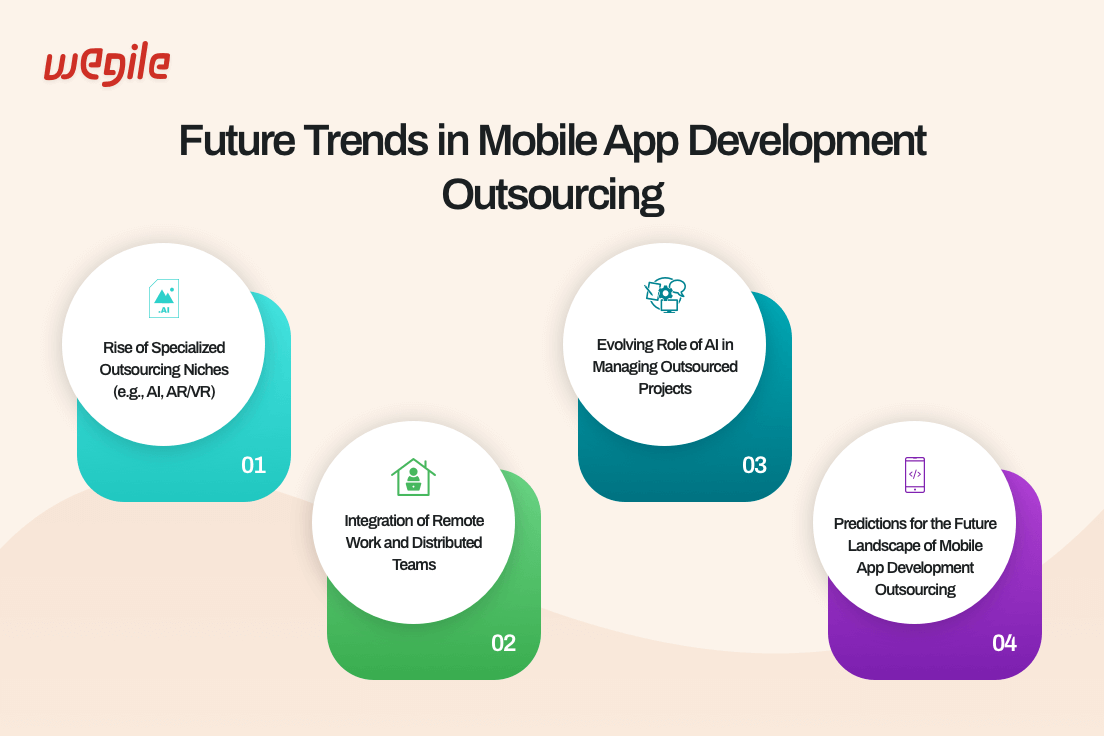
A. Rise of
Specialized Outsourcing Niches
(e.g., AI, AR/VR):
Niche Expertise: The outsourcing market will witness a surge in specialized niches, such as
Artificial Intelligence (AI), Augmented Reality (AR), and Virtual Reality (VR) development.
Deeper Expertise: Clients will seek outsourcing partners with deep expertise in specific niches to
tackle complex projects and integrate advanced technologies seamlessly.
High-Demand Domains: Niche areas like AI-driven apps for personalized user experiences and AR/VR
applications for immersive engagement will see increased demand.
B. Integration of Remote Work and
Distributed Teams:
Remote Work Norms: Remote work will continue to be a significant aspect of outsourcing, with
distributed teams collaborating across different time zones.
Global Talent Pool: Businesses will leverage a global talent pool, tapping into skilled professionals
from various parts of the world.
Project Flexibility: Distributed teams offer agility, allowing for scaling based on project demands
while optimizing costs and expertise.
C. Evolving Role of AI in Managing
Outsourced Projects:
AI-Powered Project Management: AI-driven tools and platforms will become integral in managing
outsourced projects efficiently.
Predictive Analytics: AI algorithms will predict potential bottlenecks, project risks, and deviations
from timelines, enabling proactive mitigation.
Enhanced Communication: AI chatbots and virtual assistants will facilitate real-time communication
and address queries, fostering transparency and swift issue resolution.
D. Predictions for the Future Landscape of
Mobile App Development Outsourcing:
Increased Collaboration: Collaborative tools and platforms will continue to evolve, fostering
seamless communication and real-time collaboration among remote teams.
Rapid Prototyping: Faster development cycles, enabled by low-code and no-code platforms, will
facilitate rapid prototyping and iterative development.
Quality Assurance: Outsourcing will see an increased emphasis on rigorous quality assurance
processes, including automated testing, to ensure bug-free and user-friendly apps.
Security First: Heightened cybersecurity measures will be implemented in outsourcing to protect
sensitive data and user privacy.
Sustainability Focus: Companies will consider environmental sustainability when outsourcing, looking
for partners with eco-friendly practices.
Agile and DevOps Adoption: Agile methodologies and DevOps practices will be the norm, ensuring
flexibility, continuous integration, and faster time-to-market.
Blockchain Integration: Blockchain technology may be increasingly integrated into outsourced app
development for secure and transparent data handling.
5G-Powered Apps: With the proliferation of 5G networks, outsourced apps will leverage high-speed
connectivity for enhanced user experiences.
IoT and Edge Computing: Outsourcing of IoT and edge computing app development will grow as the
Internet of Things expands.
If you are planning to outsource mobile app development, keep in mind the aforementioned future
trends in mobile app development outsourcing to ensure your mobile app outsourcing projects are a
complete success.
When it comes to turning your dream mobile application into an actual product, nothing compares to
having a team of expert outsource mobile app developers, experienced in the latest mobile app tech
on your side.
With Wegile, you get the best of both worlds: top-notch expertise and a cost-effective solution so
you can stay within your budget. Plus, Wegile provides timely and responsive customer service so
that you always have peace of mind knowing we are looking out for you every step of the way. Trust
us to make your vision come to life and outsource your mobile app development to Wegile today!
Leave a Reply