
Introduction
Hadoop has become a mainstay in the industry, offering fast
access and comprehensive analysis of huge datasets. By identifying correlations and patterns unseen
by conventional methods, it delivers deeper insights into any process or system. Meanwhile,
Spark is all about speed and scalability. It’s designed to
work with distributed frameworks so you can quickly perform operations on large amounts of data.
Learn more about the power of Hadoop and Spark – and how to use them for maximum effect in your
analysis projects. With our in-depth exploration and insightful guidance, you’ll soon be mastering
the art of real-time analysis by understanding the differences between Hadoop and Spark, along with
the similarities between Hadoop and Spark that they share.
Differences Between Hadoop and Spark
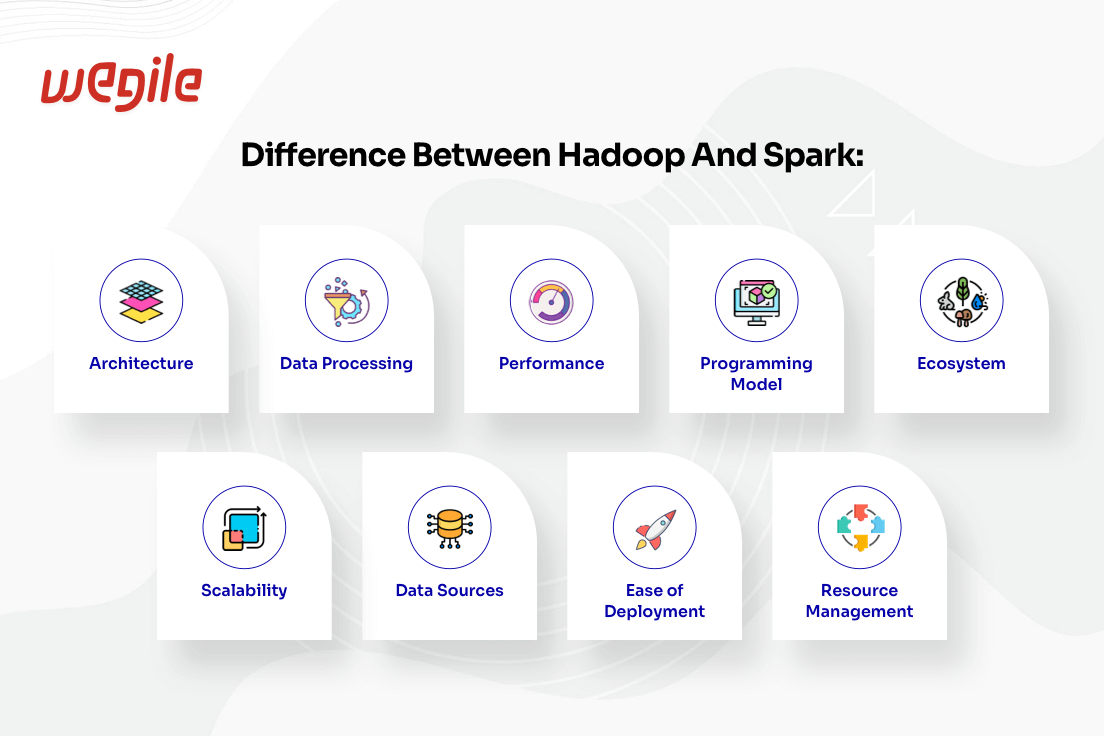
Architecture: Hadoop is a distributed computing
platform built around commodity hardware, meaning that it is highly scalable and requires no costly
or specialized hardware. Spark’s architecture uses in-memory caching and optimized query execution
to run computations in memory, making it significantly faster than Hadoop when dealing with
high-performance computing for data analysis.
Data Processing:Hadoop is designed for batch
processing, which works well with large volumes of data that do not require fast input/output
operations. Spark allows for both batch processing of large datasets as well as stream processing,
enabling real-time analytics.
Performance: Hadoop’s batch processing system works
well with high-volume, non-interactive operations. Its stream processing of large datasets is often
slow and inefficient compared to Spark’s. Spark enables users to get faster results due to its
in-memory computing capabilities and powerful optimization engine.
Programming model: Hadoop’s programming model is
MapReduce, while Spark offers a higher-level API with a range of supported languages, including
Java, Python, and Scala.
Ecosystem: Hadoop has an extensive set of components
and services, including HBase and Pig for data storage and processing, as well as popular platforms
such as Apache Hive for data analysis and Apache Mahout for machine learning. Spark also has a rich
ecosystem but lacks the mature components found in Hadoop.
Scalability: Hadoop is excellent at distributing large
amounts of data across a cluster of machines, while Spark works best with smaller data sets that
require larger computing memory.
Data sources: Hadoop works with structured,
semi-structured, and unstructured data, while Spark is mainly used for structured datasets.
Ease of Deployment: Hadoop is more difficult to deploy
than Spark due to its complicated architecture and many components. Spark is easier to deploy since
all the complex stitching between components is managed by its own integrated system.
Resource Management: Hadoop’s resource-management
system is baked into the framework, ensuring that MapReduce jobs are properly allocated resources,
even for workloads with wildly differing pipelines. Spark’s resource-management system is based on
Apache YARN, which offers much more flexibility in how data is processed and takes advantage of
available computing resources.
Use cases: Hadoop is great for batch processing, while
Spark is better suited for iterative jobs that need faster speeds, such as machine learning, stream
processing, and interactive querying.
Similarities Between Hadoop
and Spark
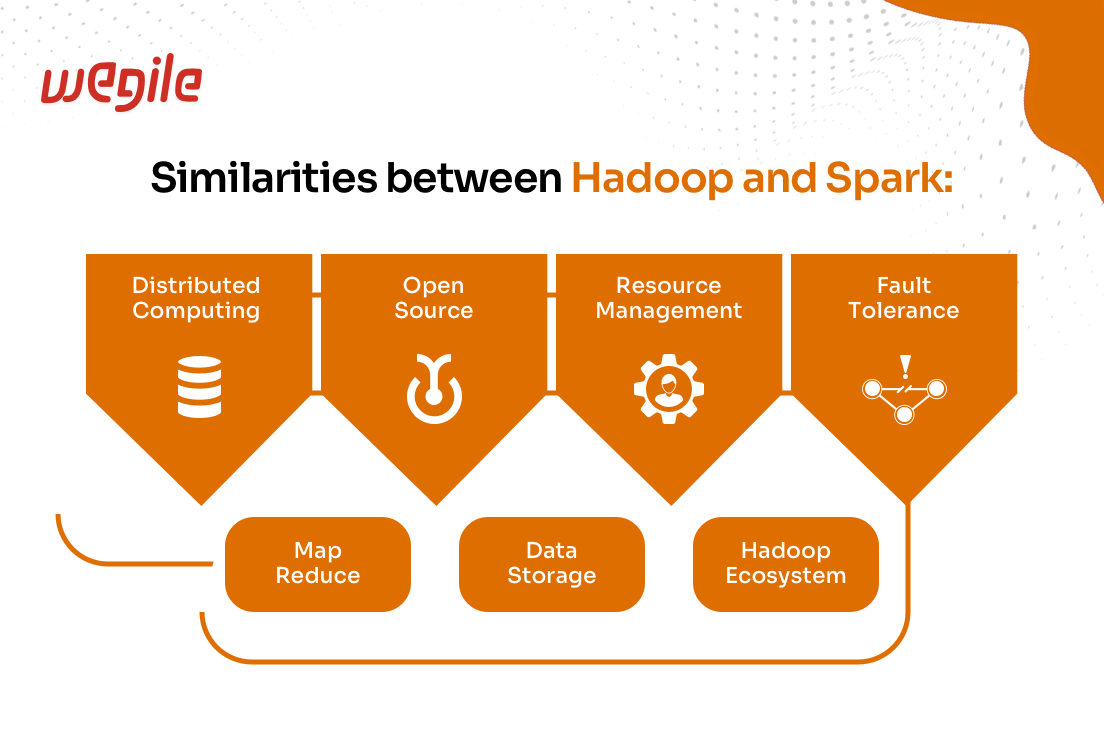
Distributed computing: The power of Hadoop and Spark
lies in their distributed computing capabilities, allowing for efficient data processing across
multiple nodes. Perfect for harnessing collective computing power, these systems are unparalleled in
their ability to accelerate workloads and optimize resource utilization.
Open-source: Hadoop and Spark are essential,
open-source Big Data solutions that provide unprecedented levels of customization, enabling
developers to craft powerful, tailored software. With the flexibility to modify and extend existing
features, these platforms bring untold potential for developers.
Resource Management: Both Hadoop and Spark use their
own resource management systems, referred to as “YARN” (Hadoop) and “Mesos” (Spark). These systems
manage resources such as CPU cores and memory across the cluster, allowing distributed tasks to be
executed with minimal interference.
Fault tolerance: Hadoop and Spark are the epitome of
reliability and stability, staying ever-resilient to node failure, so even if catastrophe strikes,
you can rest assured that your system will remain safe and secure. Hadoop’s innovative mechanism for
recovery is unrivaled in its ability to get those nodes back up and running, while Spark takes a
slightly different approach, leveraging RDD Lineage to ensure fault tolerance.
MapReduce: Spark offers incredible speed and
flexibility through its superior RDDs and DAG executor. In addition, it allows for seamless
integration with existing Hadoop code and supports massive batch operations for the most demanding
datasets – making sure that no obstacle stands in your way.
Data Storage: Drawing similarities between Hadoop and
Spark, both technologies leverage distributed file systems – namely HDFS and S3 – to safeguard
valuable data.
Hadoop Ecosystem: The Hadoop ecosystem is transformed
through Spark’s superior integration. Seamless compatibility with technologies such as Hive, Pig,
and HBase enables developers to unlock the potential of data-driven computing and revolutionize
their workflow.
How Spark and Hadoop Process Data
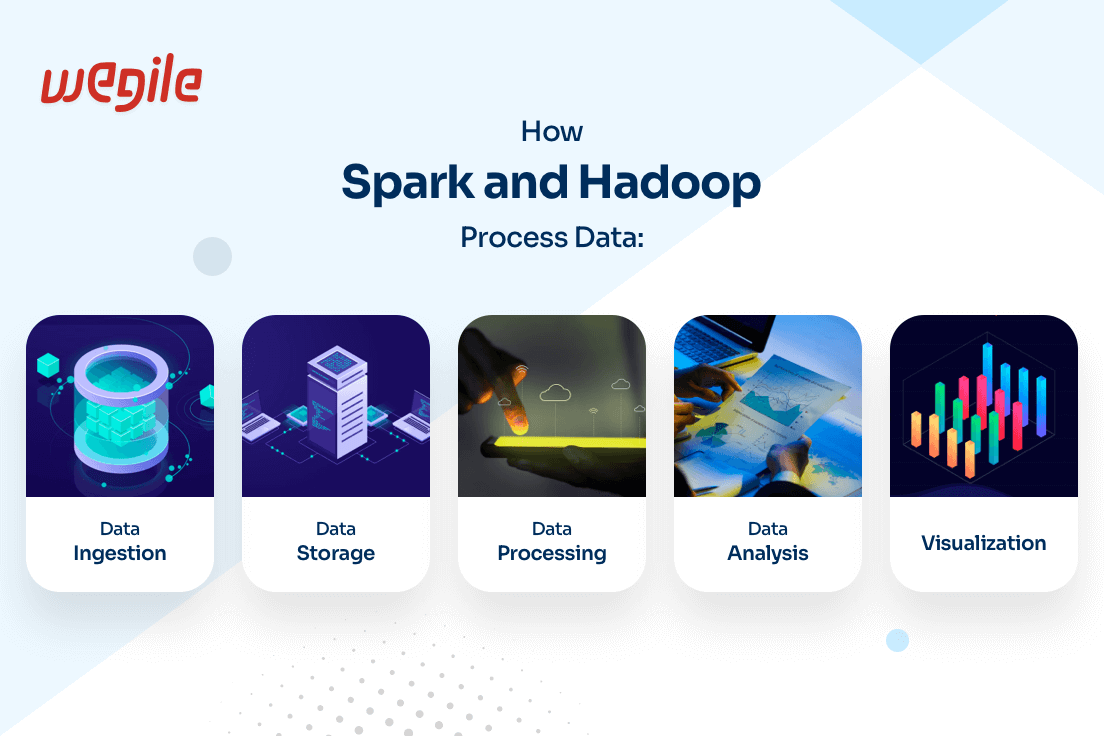
Both Spark and Hadoop process
data in different ways; here is how Spark processes data:
-
1. Data Ingestion: Spark gathers data from
distributed sources such as HDFS, S3, and even local sources via SQL and streaming APIs. -
2. Data Storage: The acquired data is saved in
the distributed file system of choice so that it can be accessed for further processing. -
3. Data Processing: Spark then uses machine
learning algorithms to process the stored data, transforming it into meaningful information. -
4. Data Analysis: Spark utilizes SQL-like query
structures to analyze and compare the results provided by data processing. This helps us to
detect patterns, answer complex queries, and make strategic decisions. -
5. Data Visualization: The final step is
visualizing the processed and analyzed data using tools such as Tableau and Power BI to gain
actionable insights.
Here’s how Hadoop Processes
data:
-
1. Data Retrieval: Hadoop gathers data from a
wide selection of outlets, such as HBase, HDFS, local machines, and more. It adeptly fetches
this data to be further scrutinized and handled. -
2. Data Storage: After retrieving the data, it
stores it in data nodes in HDFS (Hadoop Distributed File System). -
3. Data Processing: This is the core step in
Hadoop, where it applies the logic/algorithm to the data stored in data nodes and generates
output. This step can be broken down into two stages:
i. MapReduce
ii. JobTracker -
4. Data Analysis: The output from the Data
Processing phase is analyzed and applied to generate insights from the data. -
5. Data Visualization: Finally, the analyzed data
and insights are visualized using various tools like Apache Zeppelin, Tableau, etc.
Conclusion
In conclusion, Hadoop and Spark are two noteworthy big data technologies with the capability to
process data in distributed settings. Hadoop is specifically tailored for batch processing, while
Spark offers both batch and real-time solutions. Hadoop’s architecture relies on cost-effective
hardware components and an established ecosystem of elements like HBase and Pig.
In contrast, Spark utilizes in-memory caching processes and enhanced query execution to facilitate
faster performance than Hadoop. Moreover, Spark provides a comprehensive programming model with
comprehensive language backing while they both share advantages such as open source availability,
fault tolerance, resource management systems, and distributed file systems like HDFS/S3 for data
storage.
Leave a Reply